
Accurate Doesn't Mean Understood
Jun 17, 2026
Author: Caroline Petersen | Editor: Steve Korver | Imagery: Zoe Mazlin
Reading time: 9 min
Buyers need a way in before they can buy in.
You described your product thoroughly. You used the right terms. You explained the architecture, the workflow, the outcome. Every word is technically correct. And still, nobody knows what you do.
This is the first failure mode in B2B go-to-market communications. It's not laziness or bad writing. It's precision without translation. You wrote for yourself, for your team, for the people who already understand the problem deeply. You did not write for the person sitting across the table who has fifteen other vendors in their inbox and thirty seconds to decide if you are worth their time.
The second failure mode is harder. You are not just using the wrong words. You are building a category that does not exist yet. There is no familiar name to borrow, no obvious comparison point, no established mental model the buyer can reach for. Before they can evaluate you, they need to know how to categorize you.
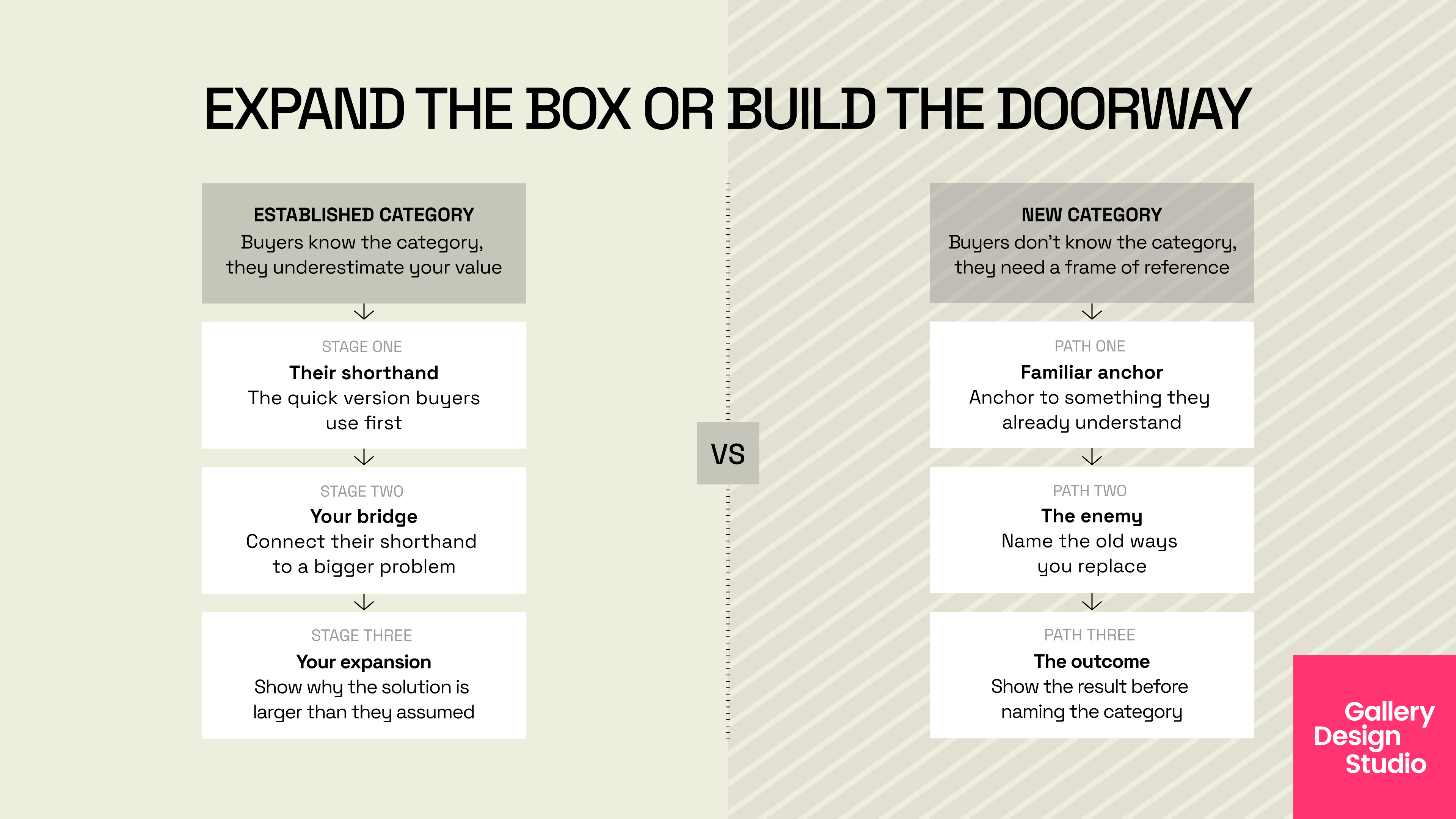
If they already have a box for you, your job is to expand it. They may understand the general category, but they are likely underestimating the value. They use shorthand. They reduce the solution to the first familiar thing they can name.
If they don't have a box for you yet, the job is different. You have to build the doorway. You have to give them a way into the idea before asking them to understand the full category.
Both problems share the same root. The buyer needs a frame of reference before they can evaluate your value. If you don't give them one, they'll create one themselves. And the one they create is almost always smaller, simpler, and less valuable than what you actually are.
The Language Gap Is Measurable
A recent study by Basis Global compared how brands describe themselves with how buyers talk about them in real peer conversations. It turns out that 83% of what buyers say about B2B brands contradicts how those brands describe themselves. The overlap between brand language and buyer language sits at around 14%.
That's a structural disconnect, not a messaging tweak. And it shows up directly in shortlists, in stalled deals, and in the conversations you never get to hear.
The cost is just as stark. According to Forrester's 2024 Buyers' Journey Survey, 92% of buyers start with at least one vendor in mind before formal evaluation begins, while 41% already have a single preferred vendor selected. They are not browsing when they take your meeting. They are confirming.
Research from Capterra, across more than 3,300 software buyers, shows the initial shortlist is shaped heavily by vendor familiarity and that most buyers make their final pick from that list. That familiarity is now being reshuffled by AI: half of buyers start their research in a chatbot, and a third end up buying from a vendor they'd never heard of. The other two-thirds still go with names they knew. AI is loosening the familiarity lock, not breaking it.
Which only sharpens the point: if a chatbot is the one summarizing you to the buyer, your language had better already be theirs because you are not in the room to translate.
The vendors on the shortlist got there before anyone spoke. They got there because when the buyer described the problem to a peer or a bot, one name came out naturally. That is not brand awareness. That is language alignment. And it happens long before your sales team gets involved.
Brands lean on familiar positioning terms like "innovative," "trusted," "strategic partner," and "all-in-one." Buyers, especially closer to a decision, default to more practical, defensible language. They need a sentence that travels from the evaluation meeting to the budget conversation to the sign-off email. And it has to survive the forward to the CFO, both in writing and on the slide, not just in the room with a rep there to explain it.
If your positioning doesn't give them that sentence, they'll write one themselves. And the one they write will be simpler, flatter, and smaller than what you actually do.
When the Buyer Understands You Too Small
We worked with a client in document intelligence. Their software ingests documents, reads them, routes them to the right team member, and triggers the next action in the workflow. It removes a layer of human coordination that costs operations teams hours they stopped counting years ago.
The buyer described it to their CFO as a file naming tool.
That description isn't wrong. The software does interact with files. But it is nowhere near complete. It describes the surface behavior, not the business outcome. And a file naming tool doesn't get $80,000 a year in budget. Intelligent document routing might.
This is what happens in an established category. Buyers have a box for you, but the box is too small. They know enough to categorize you, but not enough to understand why you matter.
Here is where most companies make the mistake. They correct the buyer. They explain what the software really does — that the routing logic alone saves twelve hours a week per team. All of that is true. None of it lands. Because the buyer is now defensive. They used the wrong word and got a lecture. That is not a buying experience.
The move is not a correction. The move is expansion.
You start where the buyer is. "If your team is still manually sorting and assigning documents today..." You enter their language. You accept the shelf they reached for. Then you widen it until it holds everything you actually do.
Their shorthand isn't the enemy. It's the entry point.
The Harder Problem: When There's No Box Yet
The file naming story has a saving grace. The buyer had a word, even if it was incomplete. There was a shelf, even if it was the wrong one. You could borrow it, anchor there, and expand.
New category creation removes that option entirely.
If you are building something that has never existed before, the buyer has no shelf for you. And when a buyer can't place you, they don't engage. They move on to something they understand.
This is the moment most category creators reach for the grand declaration. The bold new name. The manifesto. The category with a capital C. That instinct is understandable and almost always wrong. You can't name your way into a buyer's head. You can only enter through a door they already have.
If buyers don't have a box for you, build the doorway.
Three Ways to Build the Doorway
- The Familiar Anchor
You anchor to something the buyer already understands, then create distance from it.
The point is not to trap yourself in someone else's category. The point is to borrow recognition long enough to create distinction. This is not the lazy "Uber for X" version of positioning. The analogy is not the destination. It is the doorway.
For example: "Like a CRM, but for the work that happens before a deal exists."
The buyer has a familiar anchor. You borrow it just long enough to show why your thing does not fit there. That gap is where the new category begins. - The Enemy
You skip the label entirely and name what you replace. The buyer knows their current pain. They know the spreadsheet their ops team is still using. They know the manual process no one has fixed. Define the category by what it kills, and the buyer places you immediately. It's not because they understand the new thing, but because they deeply understand the old thing you are ending. - The Outcome
You do not introduce the category at all in early materials. You show the specific, concrete result the buyer gets. Let them experience the outcome before they have to process the label. Let them ask, "What is this?" That question is the opening. The category name lands in a conversation, not on a homepage. By the time you name it, the buyer already wants it.
In all three cases the sequence is the same. The buyer's existing understanding comes first. Your accurate, complete description comes second.
You have to earn the right to widen the category. You don't demand the buyer adopt yours on arrival.
A LinkedIn and Bain study across 500+ senior buyers found that brands are over 20 times more likely to be bought when everyone in the buying group recognizes them at the outset. In new category creation, that recognition doesn't exist yet. The only way to build it is through the language the buyer already has and not the language you wish they had.
Sequence Beats Accuracy
Accuracy isn't the problem. Sequence is.
The best messaging frameworks are built on real buyer language, not marketing intuition. That means sales call transcripts, support tickets, win/loss interviews. The exact words buyers use to describe the problem before they know your product exists. That is the vocabulary you meet them with. Your precise language comes second. It comes once you are in the room, once the conversation has started, once the buyer has nodded at something familiar and is ready to go further.
68% of B2B buyers already have a front-runner vendor in mind at the very start of their purchasing process, and 80% of the time that front-runner wins, according to Forrester. Recognition comes from familiar language; trust comes from delivering on what that language promised.
The buyer who understands you simply in week one and understands you fully by week four is a buyer who can move. The buyer who encounters your technically accurate positioning on day one and can't explain you to their team by day two is a buyer who goes quiet.
Start with their words. Earn the right to replace them.
If they already have a box for you, expand it. If they don't, build the doorway.
About Gallery Design Studio
Gallery Design Studio is a go-to-market creative partner for high-growth B2B technology companies. We work with a select number of companies to plan, structure, and produce the strategic visual content that moves complex deals forward. By invitation only. gallerydesignstudio.com


