
Moat Stacking: How to Win When Your Product Isn’t 10x Better
May 27, 2026
Author: Caroline Petersen | Editor: Steve Korver | Imagery: Zoe Mazlin
Reading time: 8 min
Most products aren’t that different from the competition.
Someone wins the deal anyway.
That’s the market most companies actually operate in. Not a race to build something revolutionary. But rather a fight for credibility in a category where products are roughly equivalent and buyers are mostly trying to avoid making a mistake.
Dentsu's 2024 Superpowers Index found that 68% of B2B buyers say vendors all sound alike—yet 71% of marketers believe their messaging is unique. Same market, completely different perception. That gap is where deals are lost before the first meeting is booked.
What’s deciding those deals? Purchase decisions are driven 59% by the overall buying experience and just 41% by the product itself. In other words: how you show up outweighs what you sell.
The companies that win aren’t the ones with the best product. They’re the ones buyers trust most, perceive as lowest risk, and have encountered often enough, and in the right contexts, that the choice feels like a foregone conclusion.
That’s not a fluke. It’s a system. And most companies never build it.
The AI Acceleration Problem
This dynamic has always defined relationship-driven industries. What’s new is the speed at which it is spreading everywhere else.
Artificial intelligence is collapsing the time it takes to look competitive. A company that eighteen months ago required a full engineering team and a year of runway can now ship something credible in weeks. Feature gaps that once took years to close are closing in quarters. In some software categories, benchmark leadership changes hands monthly.
The result is a market where differentiation is harder to sustain and easier to imitate than at any point in the last two decades. Every company claims to be faster, smarter, AI-powered, and more efficient. Increasingly, those claims are true.
Capability is no longer the differentiator. It is the entry fee.
The companies that build durable positions over the next decade will not necessarily be the ones with the best models. They will be the ones that built something AI cannot replicate on a timeline that matters: trust, contextual credibility, and a track record that speaks for itself.
The Trap: Competing on What Everyone Can Match
Consider a company looking to expand into a new vertical. Strong offering. Custom software development. Competent team. Real track record.
But not unique. Dozens of firms do what they do. Several do it cheaper.
The market they wanted to enter was relationship-driven. Decisions made over years, not quarters. Reputation weighted more heavily than feature sets. The kind of environment where a new entrant is not evaluated primarily on capability. They are evaluated on fit, on familiarity, on whether the buyer can defend the choice internally if something goes wrong.
In markets like this, being technically better is the price of entry. The real question buyers are asking is not who has the best product. It is: do you understand our world, have you worked with organizations like ours, and can we trust you when the stakes are high?
Most companies try to answer that question with a better deck. The ones that win answer it with a better track record.
A Better Analogy Than Restaurants
The standard analogy for competitive markets is restaurants: a city doesn’t need just one, so multiple providers can coexist. It’s a reasonable observation. It’s also the wrong frame.
Restaurants don’t compete for the same customer on the same night with the same budget. B2B vendors do.
Airlines are the better model. Similar aircraft, similar routes, similar safety records across carriers. Yet some consistently take more share, charge higher yields, and retain customers through downturns.
Not because of one thing. Because of many: on-time performance that compounds into reliability perception, loyalty programs that raise switching costs, communication quality that signals operational discipline, brand trust built over decades of consistent execution.
Each advantage is marginal. Together, they are decisive.
What Is Moat Stacking?
Moat stacking is the deliberate construction of multiple small, defensible advantages across a business, none of which is sufficient alone, but which, in combination, create a position that is genuinely difficult to displace.
It is not about finding one breakthrough differentiator. It is about making ten incremental improvements across the dimensions that actually drive trust and buyer confidence, and ensuring they reinforce each other.
The goal is not to be better. It is to be undeniable.
The Six Layers
In relationship-driven markets, where trust is the primary currency of exchange, six categories of advantage tend to compound most reliably.
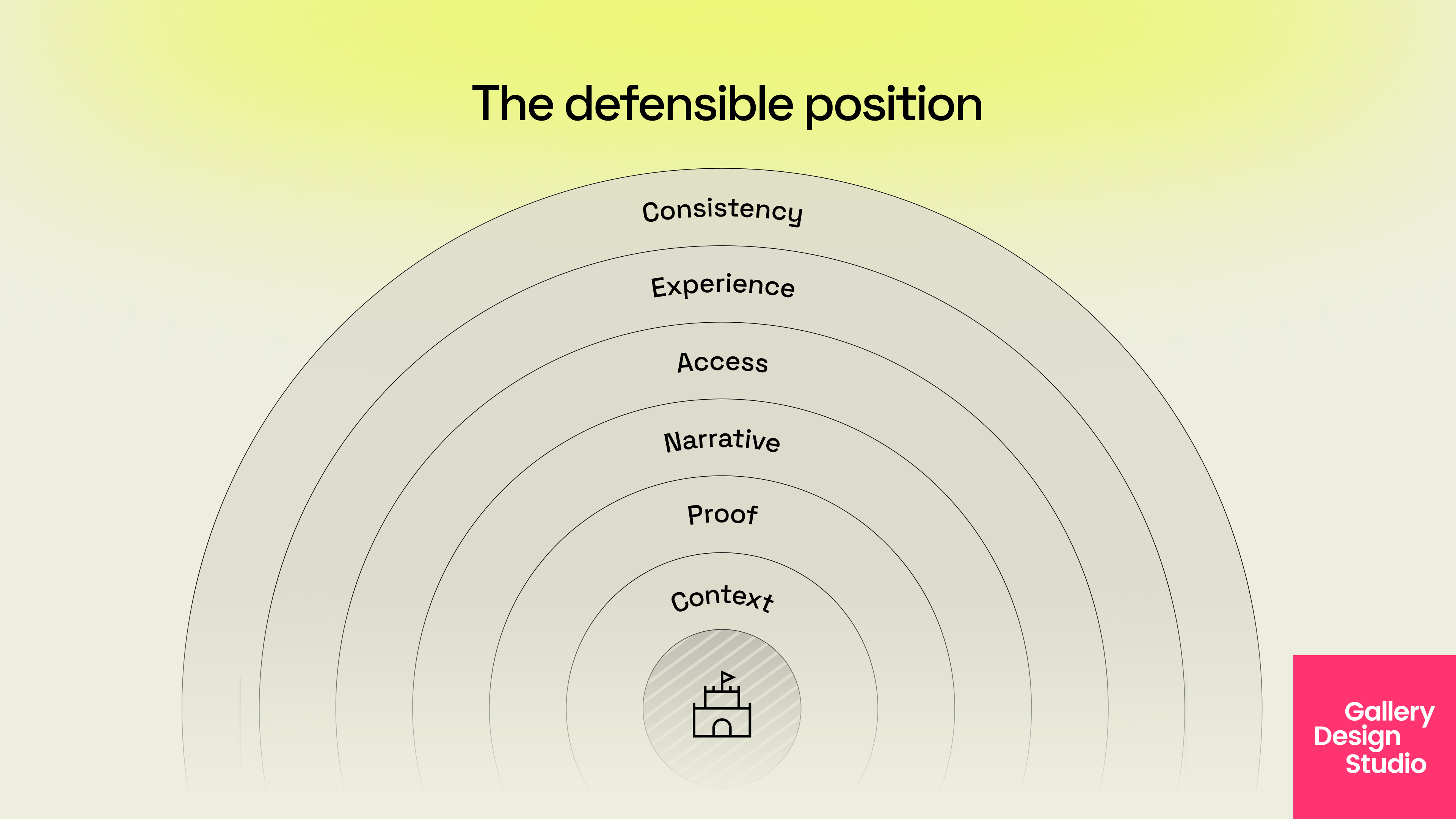
Context
Understanding not just what a market does, but how decisions are made inside it, what pressures operate beneath the surface, and what success looks like to the person responsible for the outcome. Most competitors engage at the surface. Depth of understanding is itself a form of differentiation.
Buyers notice when you know their world. They notice faster when you don’t.
Proof
Specific, recognizable evidence that you have delivered results for organizations that resemble the buyer’s own. Case studies, named outcomes, reference accounts. The question every buyer is asking, consciously or not, is: have you done this before, with someone like us? A few precise answers outperform a library of generic ones.
Proof does not just build confidence. It transfers risk from the buyer to the vendor.
Narrative
Messaging that reflects the language, priorities, and concerns of a specific market rather than a general audience. Not a rebrand. A signal. When a buyer reads your materials and thinks “this was written for us,” you have already outpaced most of the competition.
If you sound like a generalist, you will be priced like one.
Access
Presence in the environments where decisions are actually shaped: the industry associations, the informal networks, the trusted intermediaries. In insular markets, the ability to get a warm introduction is worth more than any marketing budget. You do not need to outspend competitors. You need to be in the room before the RFP is written.
Access is not a relationship strategy. It is a revenue strategy.
Experience
The quality of the working relationship itself. How you communicate under pressure, how you handle the inevitable moments of ambiguity, how easy or difficult you make it for the client to do their job. In trust-based markets, the product and the experience of buying it are inseparable.
Buyers remember how a vendor made them feel long after they’ve forgotten the feature comparison.
Consistency
Trust is not built in a single interaction. It is the result of doing what you said you would, repeatedly, over time. Showing up prepared. Delivering without being managed. Being the vendor that never creates a problem anyone has to explain upstairs.
This is the slowest moat to build. It is also the one competitors cannot shortcut.
When the Product Stops Being the Decision
As technical differences between vendors compress, buyers do not become more analytical. They become more risk-averse. The question stops being who is best and becomes who is safest.
Who understands our specific context. Who has done this before. Who will be easy to defend internally. Who feels like the kind of organization that does not create surprises.
This is especially true in enterprise and government markets, where the cost of a wrong decision is not just operational. It is political. At this scale, the wrong vendor selection can end careers.
AI accelerates this dynamic rather than resolving it. As the floor of capability rises across the market, the ceiling of trust, credibility, and contextual fit becomes the actual competitive arena.
Capabilities can be replicated. Reputation cannot. Context cannot. Trust cannot.
At least not fast enough for the buyer in front of you today.
The Strategic Reframe
Most companies spend their energy trying to prove they are better. Better features. Better pricing. Better case studies. Better deck.
The companies that win in relationship-driven markets ask a different question entirely.
Not: how do we prove we are better?
But: how do we become the assumed vendor for this specific buyer, in this specific context, at this specific moment?
That question leads to a different set of investments. Less in product marketing. More in contextual credibility. Less in outbound volume. More in the quality of every touchpoint that shapes how a buyer perceives risk.
When your product is only incrementally better than the alternative, superiority is not the strategy.
Undeniability is.
The Reinforcing Advantage
The six moats described above are not independent initiatives. They are a system. Context makes proof more credible. Proof makes narrative more persuasive. Narrative makes access easier. Access generates more proof. Experience and consistency lock in the position once it is won.
None of it requires a breakthrough product. It requires deliberate, sustained investment in the dimensions of trust that buyers use to make decisions.
As AI compresses technical differentiation across every category, the companies that survive will compete on something it cannot replicate at speed: trust that accumulates, contextual credibility, and the kind of consistency that only comes from showing up, reliably, over time.
That is what moat stacking protects.
The companies that build it deliberately will not need a breakthrough.
They will already be the assumed vendor.
Gallery Design Studio is a visual GTM partner for B2B technology companies. We work with growth teams to plan, structure, and produce the content that moves complex deals forward. See what we build at gallerydesignstudio.com.


