
Not All Feedback Is Created Equal
Sep 02, 2026
Author: Caroline Petersen | Editor: Steve Korver | Imagery: Anastasiia Hriaznova
Reading time: 8 min read
Quick Answer
- Feedback should be weighed, not collected. Four things determine a note's weight: who's giving it, how many people are giving it at once, whether it sits inside their expertise, and how it's delivered.
- What's left after those checks sorts into three types: constructive, useless, and political.
- Two decisions prevent most of the mess before it starts: a named person with final sign-off, agreed before the review, and a creative team willing to push back with a reason.
Feedback makes work better.
That's exactly why every note in a review shouldn't carry the same weight. Some notes come from real stake and real context. Others are an opinion dressed up as a directive, or a concern about the project that's really about something else.
We learned this the practical way, on a video project that ran long enough to pick up feedback from three separate rounds over several months: leadership, then stakeholders, then a later group of consultants. Each round added reasonable notes. None of them were coordinated with each other, and nobody was checking whether the video still matched its original goal as the notes piled up. A 60-second explainer became a two-minute video, and the brief quietly shifted from website asset to trade show asset without anyone deciding that on purpose.
Nothing about that is unusual. Most projects that run long enough will collect feedback from people who never talked to each other, looking at different versions, with different context. The useful question isn't how to avoid that. It's how to sort what comes in once it does.
That's what this piece is for: a practical way to weigh a note before you act on it, sort it into a type, and decide what to do with it.
Four Checks Before You Act on Any Feedback
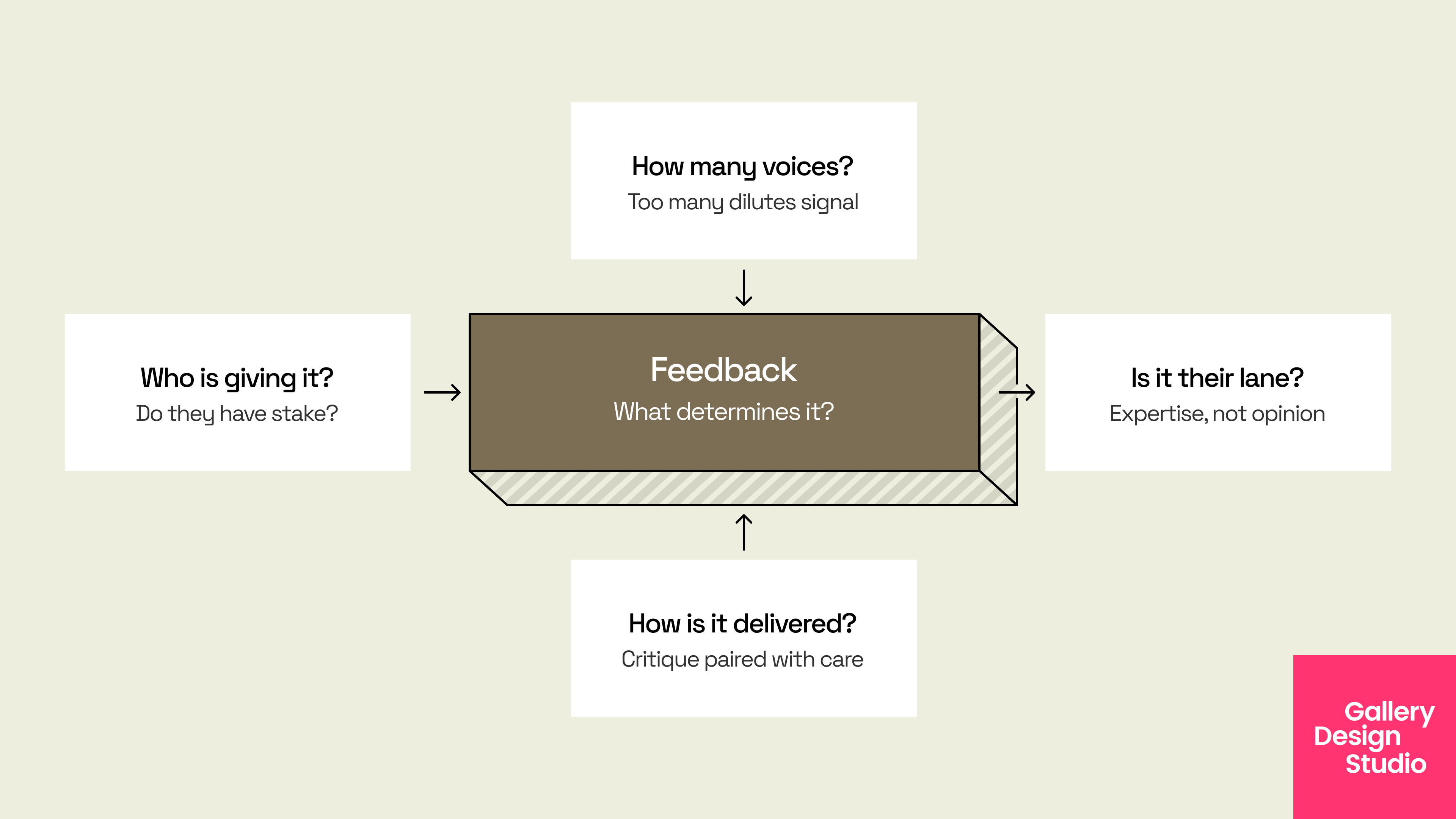
- Who’s giving it?
Three things matter:
Does their stake match their note? A client's CMO's comment on whether the messaging will resonate with their buyers could be important. The same CMO weighing in on font weight usually isn't.
Have they seen the full picture, or only the slice in front of them? Feedback from someone who saw only the final deck, without the brief, the research, or the three rounds that got you there, carries less weight than feedback from someone who's been in the process throughout. They are missing context, and that should be weighed as missing context.
Are they accountable if this goes wrong? Feedback from someone carrying no risk is cheap to give and expensive to consider. It has to earn its way in. - How many people are giving it?
The second question is simpler and gets ignored more often. How many voices are in this review, and does that number make the feedback better or worse?
Irving Janis’s work on groupthink describes how cohesive groups under pressure to agree converge on a comfortable consensus rather than the best answer, especially when a few vocal people stake out a position early.
Size wasn’t Janis’s variable, cohesion and conformity pressure were. But a bigger room supplies more of both.
Our own version is duller. Add a fourth or fifth reviewer and you don’t get more insight. You get overlapping notes, a few contradictions, and a harder job deciding which one to follow.
Rule of thumb: past three or four voices, someone has to filter which notes reach the team doing the work. Otherwise, the team serves the room instead of the client. On the video project, that missing filter was the actual gap. No single note was unreasonable. Nobody was responsible for the cumulative effect of five reasonable notes landing on top of each other. - Is it in their lane?
This is the check that gets missed most. A note should carry weight in proportion to the reviewer’s expertise in the specific thing they’re commenting on, not their seniority overall.
C. Northcote Parkinson named the pattern in 1957. His Law of Triviality describes a committee that waves through a multimillion-pound nuclear reactor in two-and-a-half minutes, spends 45 minutes on a bike shed, and burns over an hour on the coffee budget. Evaluating the reactor takes expertise. The bike shed and the coffee don’t, so everyone has something to say, and the easy items eat the room.
We see it constantly. An engineer with deep, valuable product knowledge weighs in on whether they personally like teal. That’s an opinion, but it isn’t expertise, and it shouldn’t carry the same weight as their read on whether the technical claims in the deck are accurate. Instead of ignoring the engineer, you route their feedback to where their expertise applies and treat the color as one data point, not a verdict.
This is also where feedback can start to feel personal rather than useful. A note that falls well outside someone's actual responsibility, delivered with unusual confidence, is worth a second look before you treat it as a verdict on the work. - How is it delivered?
The first three checks assume the note itself is the problem. Sometimes the note is fair but how it’s delivered is what does the damage.
We see it most when clients give notes to design teams. A round comes back as a wall of what’s wrong, with nothing about what’s working and no sense that two teams are solving a problem together. Every round starts to feel like an audit. The work doesn’t improve. It becomes defensive, over-corrected, or slow, as the team braces for the next hit instead of building on the last round.
Roy Baumeister’s paper on why bad is stronger than good found that negative information carries more psychological weight than positive information of equal magnitude, across nearly every domain studied. So an all-negative feedback stream lands much heavier than the giver intends.
Kim Scott’s Radical Candor is useful here because it doesn’t ask you to soften the note. It asks you to hold two things at once: care personally about the team, and challenge them directly on the substance. Challenge without care reads as an attack and teams stop trusting it. Care without challenge becomes vague reassurance that helps nobody.
In practice, that isn’t the classic “shit sandwich.” Praise wrapped around a critique buries the critique, and most people can spot the formula. It means naming what’s working, specifically, in the same breath as the fix, so the note reads as “here’s how we build on what’s already strong.”
Our standard, for our own team and for any client: a round of feedback should name at least one thing that’s working, specific enough that the team can tell it wasn’t a courtesy.
Three Types of Feedback
Run a note through those four checks and it usually sorts into one of three buckets.
- Constructive feedback is specific, focused on the work rather than the person, and gets sharper the more you press on it.
- Useless feedback isn’t malicious, just off target. The engineer on teal. The stakeholder commenting on something they saw for 30 seconds. A personal preference dressed as professional judgment. So, it needs to be weighed correctly and usually set aside.
- Political feedback is framed as concern for the project but is about protecting turf or positioning the reviewer. Jack Gibb’s 1961 work on defensive versus supportive communication climates provides a useful frame: feedback that evaluates without inviting conversation triggers defensiveness and shuts a room down, while feedback that describes a specific problem and invites joint problem-solving opens it up. Political feedback almost always falls on the closed-off side of that line, even when it borrows collaborative language.
The tell is the follow-up question. Ask what specifically isn’t working. Constructive feedback gets more specific. Political feedback gets vaguer or jumps to a different complaint.
This is the useful part of sorting: you can agree with the substance of a note and still separate it from a conclusion that doesn't follow from it. On the video project, a note that the runtime was too long for a trade show floor was fair on the merits. A conclusion riding alongside it, unrelated to that note, wasn't. You can hold both at once, agree on the fact, and set the rest aside.
How to Respond Without Armoring Up
The instinct after being burned is to start discounting everyone, and that can be expensive. Amy Edmondson’s research on psychological safety found something counterintuitive: the better-performing teams reported more errors, not fewer, because people felt safe raising them. The teams that look cleanest are often the ones where nobody’s willing to speak up.
Three habits:
- Sort before you respond. Run the four checks in your head before you react.
- Keep the standard the same for everyone. The fastest way to lose a healthy feedback culture is to start ranking notes by title rather than relevance.
- Route feedback to where it belongs. If there’s a technical concern buried in a comment about teal, extract it and act on it.
The Two Fixes That Prevent The Mess
Sorting notes after the fact only gets you so far. Our video project is a clean example of what happens without two things decided up front.
- One name with final approval, assigned before the review
Our video received leadership approval, then a separate stakeholder round, then consultants months later, with nobody ever named as the tiebreaker when those groups disagreed. That ambiguity let the project drift. When nobody owns the tiebreaker, the loudest or most persistent voice decides by default. Project management frameworks call the solution RACI: Responsible, Accountable, Consulted, Informed. The label matters less than the rule. Accountable is one name, not a group, and we now ask for that name in writing before kickoff. Not out of distrust. Conflicting feedback is guaranteed on any project that runs long enough, and someone has to be able to settle it without every round becoming a renegotiation. - A creative team that pushes back, out loud, with a reason
This half is on the team doing the work. It's easy to absorb every note to keep the peace, especially when the client is paying the invoice. But a team that says yes to everything to avoid a hard conversation doesn't serve the project.
If a note works against the format, length, or goal, the job is to say so and explain why. "We can add this, but here's what it does to the pacing on a trade show floor" is a fair thing to put in front of a client.
Pushing back risks an uncomfortable moment. Not pushing back risks a project nobody's happy with six months later. We'd take the uncomfortable moment early.
FAQ
What makes feedback constructive rather than useless?
Constructive feedback is specific, focused on the work rather than the person, and gets sharper the more you press on it. Useless feedback isn't malicious, it's just off target, like an opinion outside someone's lane or a preference dressed as professional judgment.
How do you spot political feedback in a review?
Political feedback is framed as concern for the project but is actually about protecting turf or positioning the reviewer. The tell is the follow-up question: ask what specifically isn't working. Constructive feedback gets more specific. Political feedback gets vaguer or shifts to a different complaint.
How many reviewers should be in a feedback round?
Past three or four voices, someone has to filter which notes reach the team doing the work. Beyond that number, a bigger room tends to produce overlapping notes and contradictions rather than more insight.
Who should have final sign-off on a project?
One named person, agreed in writing before the review starts, not a group. Without a single accountable name, the loudest or most persistent voice ends up deciding by default whenever reviewers disagree.
Should a creative team push back on client feedback?
Yes, when a note works against the project's format, length, or goal. Pushing back with a clear reason, delivered directly, serves the project better than quietly absorbing every note to keep the peace.
The Bottom Line
Not all feedback should be implemented. Saying that out loud early is what keeps a project from becoming whatever the last few people in the room happened to want. Sort by who's giving the note, how many people are giving it, whether it's in their lane, and how it's delivered. What's left usually sorts cleanly into constructive, useless, or political, and each of those deserves a different response.
None of this replaces the two decisions that prevent the mess in the first place: naming who signs off before feedback gets messy, and building a team willing to push back with a reason when a note works against the project.
About Gallery Design Studio
Gallery Design Studio is a go-to-market creative partner for high-growth B2B technology companies. We work with a select number of companies to plan, structure, and produce the strategic visual content that moves complex deals forward. By invitation only. gallerydesignstudio.com


