
Why Creative Breaks Down When Teams Scale
Sep 30, 2026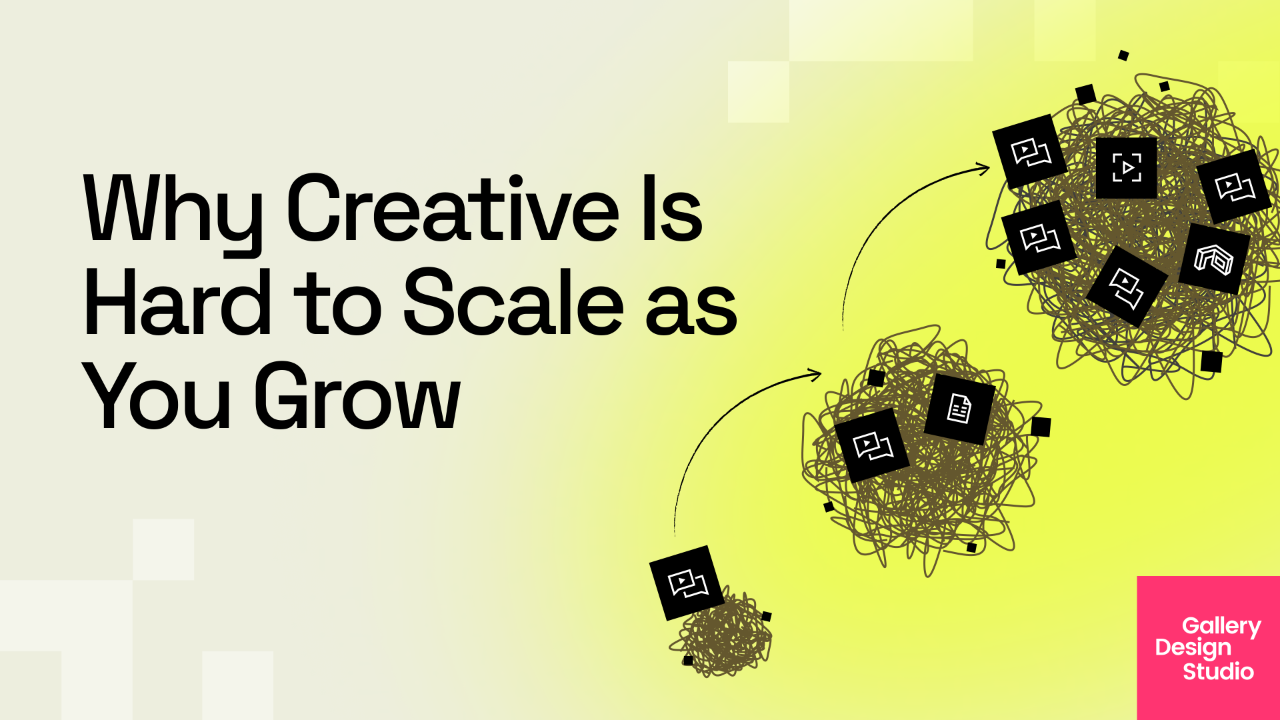
Author: Caroline Petersen | Editor: Steve Korver | Imagery: Anastasiia Hriaznova
Reading time: 6 min
Caroline Petersen founded Gallery Design Studio in 2015. Since then, she and her team have helped B2B technology companies turn their complex offerings into clear visual go-to-market content that buyers can quickly understand. She has been on both sides of the relationship described here – commissioning work from vendors and delivering it. More about Caroline.
Growth should make creative easier. There is more budget, more people, and more proof that the work is making an impact. Instead, the work gets slower and safer, and it’s hard to say when that changed.
What grew faster than the team is the number of people with a say. Each new stakeholder has a view on every asset, and every view has to be settled before anything gets made. Four things go wrong as that gap opens, and they come down to two problems. A decision problem means nobody owns what gets made, in what order. A load problem means the team has taken on more than it can finish. The two look alike from the inside, and the wrong fix makes things worse.
Key takeaways
- Production scales with headcount. Decision-making doesn’t: every added stakeholder is one more person the others have to agree with. That gap is what scaling costs you.
- A priority list changes which work waits, not how much is waiting. A nearly full team absorbs a surprise; a full one stops
- Promoting your strongest maker into the seat that owns intake is a well-documented error (Benson, Li and Shue, 2019).
- A decision problem – nobody owns what gets made, in what order – needs an owner and one place decisions are recorded. A load problem – more taken on than the team can finish – needs more capacity or fewer commitments.
- One month of measuring tells you which: log what each request named and how long it waited, and count requests in against assets shipped.
The mechanism: decisions don’t scale the way production does
Coordination cost has a known shape, and Frederick Brooks worked it out in The Mythical Man-Month in 1975. Output scales with the number of people. The channels those people maintain between each other scale as n(n−1)/2: five people have 10 connections, 20 people have 190.
Brooks was describing software, where the work itself is tangled – change one part and someone else’s breaks. Creative work isn’t like that. Two designers on two decks never have to speak, so production scales with headcount.
Decisions are the opposite. Priority, message, approval: there’s one answer, and everyone wants a say in it. Add a stakeholder, and you haven’t added a worker; you’ve added someone the other stakeholders now have to agree with. Nobody has run his arithmetic on a creative team, so that last step is a transfer, not a measurement.
For decisions, that’s exactly what the formula describes – everyone talking to everyone. Organization exists, in Brooks’s account, to prevent it. His remedy was a project workbook: one maintained record of what had been decided, so people could check it instead of asking each other.
We built one at GDS, kept current by our Creative Operations Manager, Lacey. It’s the thing that cuts down decisions living in someone’s head after a call.
1. The person who owns the decisions shouldn’t be your best maker.
A scaling creative function needs someone whose job is deciding what gets made and in what order – a different job from making it. That means running intake and defending a priority list against people more senior. Most organizations fill the seat by promoting the strongest portfolio.
Alan Benson, Danielle Li and Kelly Shue found large-scale evidence of what that costs. Analyzing performance data on sales workers at 131 firms for a 2019 paper in the Quarterly Journal of Economics, they found that firms weight current job performance in promotions over the characteristics that better predict managerial performance, and estimated the cost as high.
The paper is about sales, so it doesn’t cover creative teams directly. The mechanism does. A strong generalist can carry a five-person team and get buried running a 20-person function, measured on a job they weren’t hired for.
2. Without an owner, every request becomes a negotiation.
When no one owns intake, no one sets a standard for what a request must contain. “We need a one-pager” tells a designer what to build and nothing about what it has to do: who it moves, away from what, and toward what decision. Production optimizes for the artifact instead of the outcome, and because creative is the last visible step before something ships, it absorbs the blame for a gap that opened three steps earlier.
In the creative operations audits we run at GDS, we have found that engagements had no written business outcome attached to most inbound requests. One caveat: companies call a creative operations consultancy because something is already broken, so this describes teams in trouble rather than growing teams overall.
Without an owner there is no ranked list either, so Sales believes the deck comes first and Product believes the launch video does. Every request has to be argued for, the loudest deadline wins, and work that gets bumped rarely returns to anyone’s attention.
3. The backlog grows faster than the work that caused it.
Queues don’t grow in step with load. That’s Kingman’s 1961 finding on heavily loaded queues, and traffic is the everyday version: a nearly full road moves and a full one stops. This is why a team that coped last quarter is drowning this quarter with the same people and roughly the same work. The slack ran out.
A priority list decides which work waits, not how much is waiting. Two things reduce the amount: accepting a narrower range of request types, and taking intake in a window instead of continuously. Both are decisions that need someone with the standing to make them, which is why a team with no owner tends to end up here: nobody is empowered to refuse anything, so nothing gets refused.
Past a point, though, no decision helps. A team taking on more than it can finish has a load problem, and the only answers left are more capacity or fewer commitments.
4. Fragmented days produce worse creative work.
A team can do good work under deadline pressure. It struggles in fragments. Teresa Amabile’s team analyzed diaries from 177 employees for ‘Creativity Under the Gun‘ (Harvard Business Review, August 2002) and found that high-pressure days produced real creative thinking when people felt they were on a mission, and almost none when they felt on a treadmill, switching constantly.
Rubinstein, Meyer and Evans (2001) found that switching costs rise with the complexity of the rules involved and fall when people have a cue about what comes next. They used classification and arithmetic tasks, so read it as directional, but creative work is high-complexity switching: brand rules, audience and format reload every time. Gloria Mark’s 2005 CHI study measured the resumption cost directly: interrupted work took about 25 minutes to get back to. The 23 minutes and 15 seconds quoted everywhere comes from a 2006 interview, not a published study.
Decision ownership sets how many things are open at once. Load sets whether that number can ever come down.
The strongest objection: maybe the work just got harder
This article assumes creative is breaking because the system around it failed. The serious alternative is that the work genuinely changed: the audience broadened, legal review arrived, risk tolerance fell, more people acquired a legitimate veto. Output that reads as generic may be those constraints correctly applied. If so, none of the fixes help and more process makes it worse.
Two questions separate the cases. Is the work slow and generic, or fast and generic? A broken system produces both at once. A maturing company produces safe work on time.
And when a bolder version gets killed, can the person killing it name the risk? A named risk is the company working as intended. “It doesn’t feel right for us,” from someone who wasn’t in the brief, is the system failing.
Often both are true at once. The system problem is the one you can fix.
How to tell a load problem from a decision problem
Before hiring anyone, spend one month finding out whether you have a decision problem or a load problem.
Per request, log four things: whether it named a business outcome, who set its priority, how long it waited before anyone touched it, and how many times it changed hands.
Per week, count two: requests accepted and finished assets shipped. That’s a crude proxy, not a utilization figure, and it needs no timesheets. If the first number beats the second for a month, the backlog is growing and sequencing won’t reverse it.
Wait time won’t tell you which problem you have; it’s long under both. The rest will. Vague briefs and priorities set by whoever asked last are a decision problem: the fix is an owner and a place to record decisions. Clean briefs, clear priorities and more coming in than going out are a load problem: the fix is more capacity or fewer commitments. Process laid over a team already past its limit adds to the coordination it’s drowning in.
FAQ
What if the loudest stakeholder is the CEO?
Put the list in front of them once a quarter and get an explicit yes. When they ask for something mid-quarter, show them the document they approved and ask which item drops to make room. That is a different conversation from refusing a CEO.
Does any of this apply to a team of three?
Partly. Intake ambiguity and switching costs hit small teams at least as hard, since there’s no slack to absorb them. The decision cost doesn’t bite yet: three people have three connections and everyone is in every conversation anyway. It arrives with the fourth and fifth.
When is the right answer to outsource rather than hire?
When demand spikes and recedes. Hiring fixes a gap that stays open; an agency absorbs one that closes again. Either way, outsourcing a broken intake process relocates it at a higher hourly rate and adds a handoff, so fix the decision problem first even when the load problem is real.
How do you set priorities when two executives genuinely disagree?
Not inside the creative function, and trying is the mistake. Put both requests on one list with the trade-off written beside them in plain terms: what slips if this moves up. Disagreement about priority is almost always an unsurfaced disagreement about strategy, and it isn’t creative’s to settle.
About Gallery Design Studio
Gallery Design Studio is a go-to-market creative partner for high-growth B2B technology companies. We work with a select number of companies to plan, structure, and produce the strategic visual content that moves complex deals forward. By invitation only. gallerydesignstudio.com


