
Great Work Rarely Comes From a Single Perspective
May 21, 2026
Author: Caroline Petersen | Editor: Steve Korver | Imagery: Zoe Mazlin
Reading time: 6 min
Why Design Tension Produces Stronger Outcomes
Companies are making a rational decision and getting the wrong result. They want one designer because it feels efficient: one salary, one point of contact, one clean workflow. In an era when AI can help produce polished work faster than ever, that instinct only gets stronger.
But efficiency in communication design is often a false economy. The problem is not getting something made. The problem is whether the thinking behind it was strong enough to deserve being made at all.
Why This Matters
Communication design is not cosmetic.
It is commercial.
It determines whether a company is understood quickly or ignored entirely.
In markets where products are increasingly similar, the companies that win are not always the ones with the best technology.
They are the ones that can communicate it clearly and credibly.
When communication design is weak, this breaks.
Messages become unclear.
Products feel harder to understand.
You become indistinguishable from the next vendor on the list.
And customers do not wait.
They move on.
The Problem
Simplicity at the surface creates limitations beneath it.
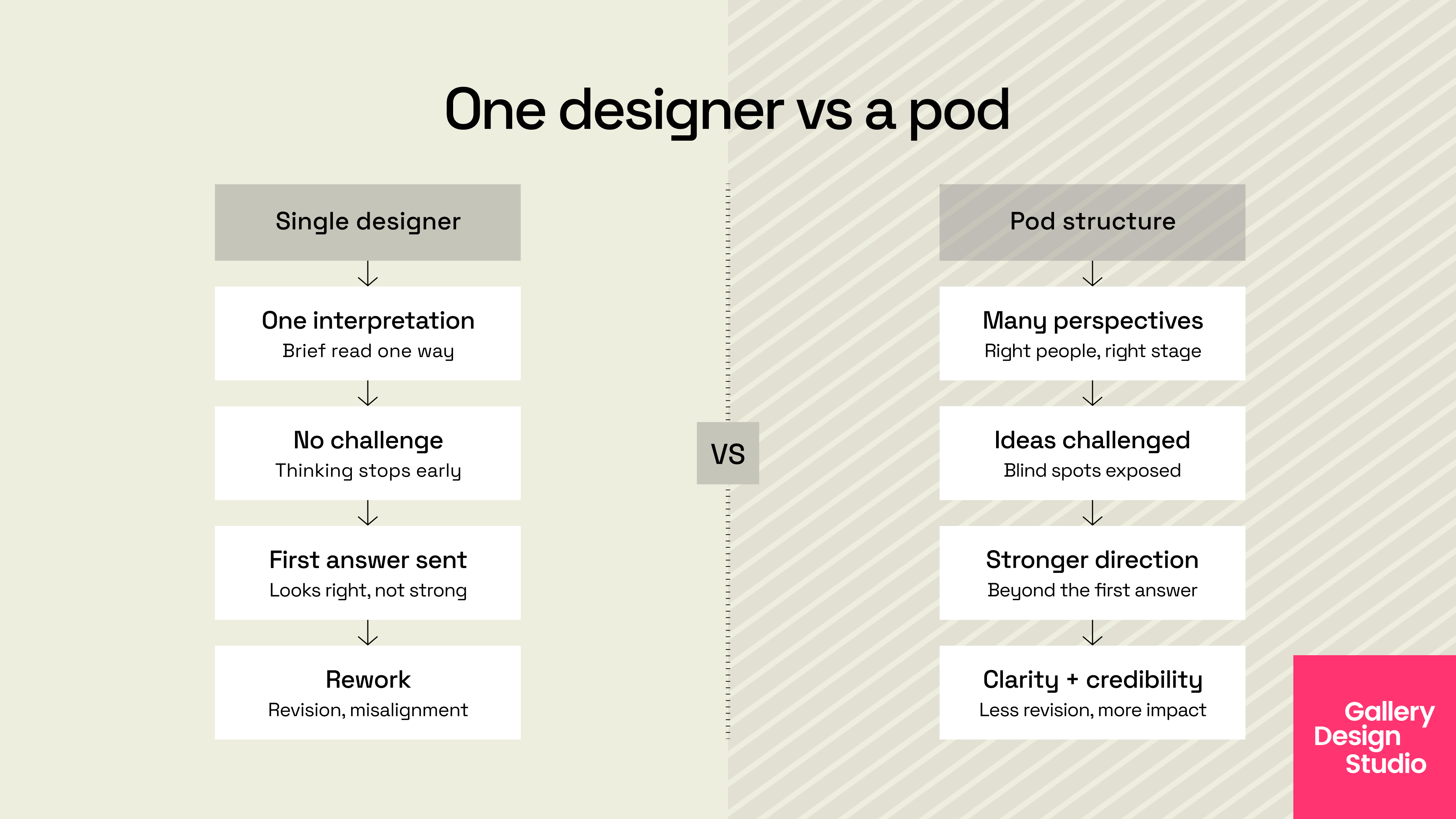
They interpret the brief one way.
They follow one path to execution.
They make decisions based on their own assumptions and perspective.
Even when the work looks strong, it has not been challenged.
And unchallenged work is rarely the strongest version.
A single designer operates within a single line of thinking.
It’s the same with a single AI tool.
When you use Claude or ChatGPT to generate design options, you are not getting multiple perspectives. You are getting one model’s pattern-matching expressed multiple times. Ten variations from the same source is not ten points of view. It is one point of view, repeated.
The speed is real. The diversity of thinking is not.
This is the same problem, running faster.
The Root Cause
The issue is not talent.
It is the absence of pressure.
Most ideas default to the most available answer:
- the familiar structure
- the expected message
- the safest interpretation of the problem
Without challenge, thinking stops early.
This is how you get work that looks right, but is not effective.
What Improves Communication Design
Better communication design comes from better thinking applied to the problem.
Communication design, at its core, is decision-making.
It is the process of determining:
- who something is for
- why it matters
- whether it is needed
- what context it lives in
- what friction it is solving
In our work, this is especially critical. Communicating complex technology is not just about making something pretty. It is about helping clients show up with the clarity, credibility, and maturity their business requires.
That requires judgment.
The Role of Human Judgment
Human judgment is what separates good from great.
It is the ability to sense when something is unclear.
It is the ability to recognize when an idea is too generic.
It is what catches a brief that answers the wrong question.
This does not improve in isolation.
It improves when ideas are exposed to the right perspectives.
That does not mean everyone should weigh in on everything.
Not all feedback is useful. Not all people are equipped to pressure test all parts of a project.
Different people are brought in for different nuances:
- a strategist to challenge the message
- a subject matter expert to test accuracy
- a product lead who knows what the product can actually do
- a creative lead to evaluate the strength of the concept
- another designer to push the execution further
This is not design by committee.
It is disciplined pressure testing.
The Mechanism
Tension is what sharpens ideas.
When the right people engage with the work at the right time, the thinking deepens:
- assumptions are challenged
- blind spots are exposed
- stronger directions emerge
This is pressure testing.
It forces the work beyond the first answer.
And the first answer is almost never the best one.
A Real Example
We recently had a client ask to work primarily with one designer in order to make communication faster, with daily stand-ups and a tighter feedback loop. The instinct was understandable. But what was missing from that request was the value that the rest of the team brings.
Other designers on the account had deeper historical context. They knew what directions had already been explored, what had been rejected, and where the visual boundaries of the brand had already been tested. Even when the goal is to push into a new direction and help the client show up as a category leader, that context matters. And just as importantly, having that one designer’s work pressure tested by the broader team is invaluable.
The answer is not to remove the team. It is to structure the team correctly. One designer can absolutely remain the sole point of contact, while still benefiting from the judgment, critique, and contextual knowledge of the group behind them.
The Misconception
The preference for a single designer is often driven by speed and budget.
Less coordination.
Fewer opinions.
Lower upfront cost.
But speed at the wrong stage creates inefficiency later.
Work that is not pressure tested early tends to be reworked.
What appears efficient at the beginning often creates drag at the end.
What looks less expensive upfront often becomes more costly through revision, misalignment, and lost impact.
The AI Reality
This dynamic becomes more important in the age of AI.
Execution is no longer the constraint.
Work can be generated quickly and at scale.
But generation is not the same as judgment.
AI can produce options and produce them fast.
However, generating ten options from a single model is not pressure testing. It is the illusion of it.
It cannot:
- challenge assumptions with intent
- understand business context deeply
- apply real-world experience
- feel when something is off
- empathize with the audience
It produces based on patterns.
It does not decide based on stakes.
That is why human-led communication design matters more now.
The Shift
Better outcomes come from systems, not individuals.
This is why we work in pods.
A group of designers, strategists, and collaborators focused on a problem.
Not everyone weighs in on everything. The point is not volume of feedback. The point is relevance of feedback.
Each person contributes where their judgment is most valuable.
We conduct regular critiques.
Not as an extra step, but as the core of the process.
Each critique pressure tests the work.
Each critique improves the outcome.
And counterintuitively, this often makes the process faster.
Because weak ideas surface earlier, and clarity builds faster than it would through rework.
The Bottom Line
Communication design does not improve through isolation.
It improves through pressure.
A single designer can produce good work.
But strong work requires multiple perspectives and the right human judgment applied to the right parts of the problem.
Gallery Design Studio maps and builds visual GTM communication campaigns for B2B tech companies. We work with growth teams to plan, structure, and produce the content that moves complex deals forward.


