
The Clarity Tax
Jul 01, 2026
Author: Caroline Petersen | Editor: Steve Korver | Imagery: Zoe Mazlin
Reading time: 8 min
The hidden cost of communicating badly.
I was at a technology conference recently. I stopped at a booth, the way you do, and within 30 seconds, a rep launched into a full product walkthrough. No questions about what I do, what I'm working on, or what problem I'm trying to solve. Just an unbroken delivery of features, differentiators, integration capabilities, and roadmap highlights, directed at no one in particular and landing accordingly.
After two minutes of attentive listening, I still couldn't tell whether I was looking at a software product, a managed service, or a consulting engagement. I walked away without a card. Not because the company didn't have something worth understanding. But because nothing in the communication gave me a reason to find out.
That company paid to attend that event. Paid to design that booth. Paid a human being to stand in it. And somewhere in a pipeline report, that encounter was recorded as a qualified lead that didn't convert.
It did not. It never started.
This is not an unusual encounter. It is the default mode of B2B marketing communication. The cost doesn't show up at the booth. It shows up across the entire sales cycle, in every deal that stalls, every shortlist that never forms, and every champion who couldn't explain the purchase to a CFO. There is a line item missing from most B2B revenue models. No CFO has ever put it in a board deck. But it is real, it is large, and it compounds across every stage of the funnel.
Call it the clarity tax: the measurable cost of the gap between a company's capability and the clarity with which it communicates that capability to buyers.
The Anatomy of a Stalled Deal
Enterprise technology buying is not a rational process. It is a risk-management process.
The average B2B purchase now involves 13 stakeholders across multiple departments, up from five a decade ago. Each of those individuals carries a different risk tolerance, a different set of priorities, and a different threshold for what counts as sufficient clarity to commit.
Only 17% of the buying journey is spent meeting with potential suppliers. The other 83% happens without them — in meetings they're not in, conversations they can't influence.
In those rooms, the materials the vendor produced do the selling. The deck. The one-pager. The follow-up email with the case study attached. If those materials are inconsistent, outdated, or disconnected from each other, the vendor is not present to correct the record. The confusion travels without a correction.
And in the neuroscience of decision-making, confusion does not create a question. It creates a feeling. That feeling is risk.
The Cognitive Economics of Confusion
When an enterprise buyer evaluates a technology partner, they are not making a purely commercial decision. They are making a career decision. A failed vendor selection does not merely miss a number. It costs the sponsoring executive credibility, standing, and, in competitive environments, sometimes their position.
Faced with that exposure, the buyer's brain does what brains do under perceived threat. It defaults to the familiar.
A DCM Insights study of more than 2.5 million recorded sales conversations found that 40 to 60 percent of B2B deals stall at "no decision." Not lost to competitors. Stuck in inertia. Across industries, "no decision" outcomes are the largest single category of deal loss, often exceeding losses to any individual competitor by a factor of two or three.
This means that for most B2B companies, the primary competitive threat is not another vendor. It is the buyer's own hesitation.
The same research breaks down why. Of no-decision deals, 56 percent stem from complexity overload: the prospect is presented with so many options that they overthink the situation and can't act. The remaining 44 percent are status quo deals, where the buyer underestimates the cost of doing nothing and defaults to their current state.
In both cases, the underlying variable is the same. Clarity. Or the absence of it.
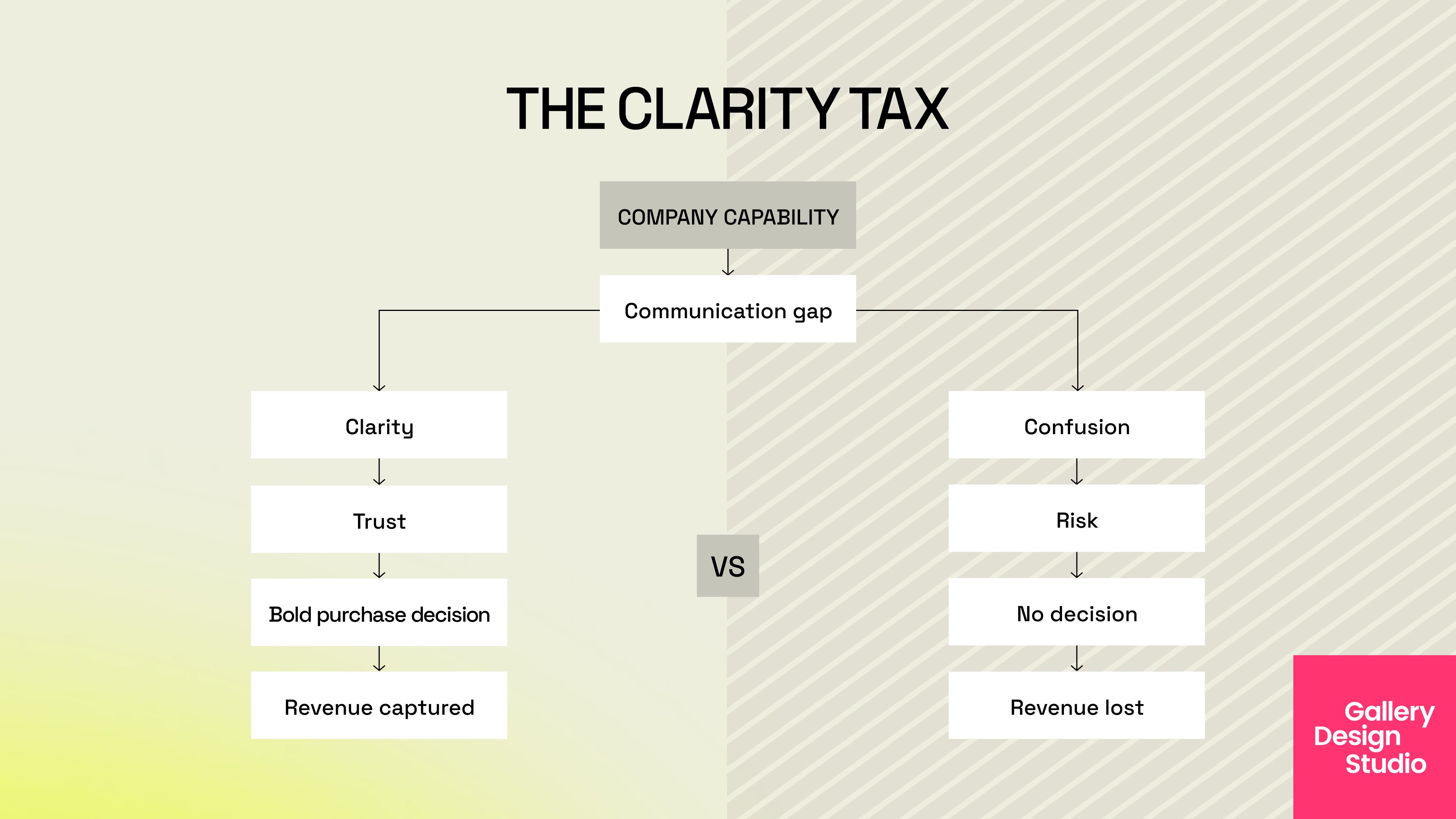
High-friction buying environments reduce purchase likelihood by 43 percent. Friction, in this context, is not procedural. It is cognitive: the mental effort required to understand what a vendor does, why it matters, how it integrates with existing systems, and what happens after a contract is signed. Every point of confusion adds friction. Every inconsistency between materials adds more.
The buyer who cannot answer those questions confidently will not champion the deal internally. And without a champion who can explain the purchase clearly to the CFO, the legal team, and the skeptical VP of Engineering, the deal does not close. Deals don't stall because one person said no. They stall because ten people couldn't say yes.
The Structural Failure
If confusion costs deals and clarity closes them, the natural question is why so many companies produce confused communication in the first place.
The answer is structural. It lives in the mechanics of how companies procure creative work.
The dominant model is transactional: a client identifies an asset need, and a vendor fulfills it. The client requests a deck, and the agency builds it. The client requests a video, and the agency builds it. The process begins at the asset level and ends there.
The result is a collection of individually competent outputs that share no common logic. The deck says one thing about the product, the video says another, and the sales rep — under-equipped and working from materials last updated two quarters ago — improvises a third narrative in the room.
The buyer absorbs all three. The signals conflict, and the conflict registers as risk.
Consider what this looks like in practice. A company releases a product update with meaningful technical differentiation. The engineering team publishes a whitepaper. The sales team is in the field with a deck prepared six months earlier. The marketing team is producing a new video that, after three rounds of revisions, will be ready in eight weeks. The launch window — the press cycle, the conference, the warm pipeline — closes before the assets are coherent.
Almost 86 percent of B2B purchases stall during the buying process. Not all of that is a communication failure. But a meaningful share of it is.
Confusion Equals Risk. Clarity Equals Trust.
There is a common misreading of the clarity problem worth addressing directly. A crowded market, the argument goes, means buyers can't distinguish among vendors. So why invest in differentiation at all?
The data says the opposite.
AI-generated content has flooded the B2B landscape with technically fluent yet contextually hollow communication. Companies can now produce more copy, decks, emails, and posts than ever before. Most of it sounds the same: polished, keyword-dense, and impossible to remember five minutes after reading. The volume has increased, and the signal-to-noise ratio has deteriorated. Buyers, already skeptical and time-pressed, have become proportionally harder to reach.
According to Forrester's 2024 Buyers' Journey Survey of 11,352 global buyers, 92 percent begin with at least one vendor already in mind before formal evaluation starts, and 41 percent have already selected a preferred vendor before the process formally begins. The market is crowded, and buyers have already done their sorting. The question is not whether they will shortlist you. It is whether you are legible enough to earn a place on the list before they stop looking.
Seventy-eight percent of B2B buyers narrow their choices to just three vendors before requesting a demo. In a market with hundreds of competing solutions, the shortlist forms early, shrinks quickly, and is heavily influenced by perceived credibility built long before a sales rep enters the room.
A crowded market does not reduce the need for clarity. It raises the bar for clarity. Buyers in saturated categories are not confused by the number of options. They are actively looking for the signal that tells them which vendor understands their problem.
According to research by SBI and Corporate Visions, the go-to-market experience drives 59 percent of the likelihood of a bold purchase decision, with the product accounting for just 41 percent. Tactically differentiated delivery causes buyers to rate an otherwise identical service as higher quality, a better fit, and a better value. The product doesn't change. The communication does. That is the clarity tax operating in reverse: when you pay it correctly, it returns more than it costs.
A separate Gartner survey found that 69 percent of B2B buyers report inconsistencies between what they see on a vendor's website and what they hear from the vendor's sales team. That gap is not a sales problem. It is a communication infrastructure problem. And it costs deals.
In 2024, 86 percent of enterprise buyers shortlisted at least one product they already knew before formal research began. TrustRadius characterized 2024 as "the year of the brand crisis," with buyers leaning heavily on familiarity and trust. Shortlists averaged two to three products, and 71 percent of buyers purchased their first-choice solution.
That means vendor selection is largely decided before the sales process formally begins. The buyer arrives with a mental shortlist. If a company is on it, the deal is winnable. If it is not, the deal is an uphill contest against embedded preference.
What gets a company onto the list? Not the biggest marketing budget. Not the most content. It is a coherent story, told consistently across every touchpoint the buyer encounters before they raise their hand — the website, the LinkedIn presence, the case study a colleague forwarded, the deck from the conference last year. All of it adds up to a single impression. Either the company looks like what it is, or it doesn't.
Making the leap from "interesting solution" to "enterprise-ready partner" is as much a communication problem as a product problem. Where there is clarity, there is trust. Trust moves deals.
What Clarity Actually Looks Like
Here is the difference in concrete terms.
Company A describes its product as "an AI-powered, cloud-native data orchestration layer that enables enterprise-grade interoperability across heterogeneous environments." Technically accurate. Completely inert. A buyer reading it cannot answer the most basic question: What does this do for me? No mental image. No felt need. No reason to continue.
Company B says: "We make sure your sales team's Monday morning data is the same data your finance team sees on Friday." Same product. The second version generates a picture, names a problem, and implies a cost of not solving it. The buyer can now explain it to someone else. That matters enormously, because explanation is how internal champions move deals forward.
The difference is not creativity. It is the willingness to be specific about the better day.
The Structural Fix
The solution is not more content. It is not a faster production process. It is not a brand refresh.
It is treating communication as infrastructure rather than output. And that requires knowing what you're communicating before you produce anything.
This means working from the top down rather than the bottom up. Not starting at the asset level, but at the idea level. What is the fundamental truth about this product? Who exactly is the buyer? What do they believe before the first conversation, and what do they need to believe to make a decision?
From that foundation, everything else follows. Brand voice. Visual identity. Content architecture. Asset production. Each output has a parent strategy. Each touchpoint reinforces the same coherent signal.
The objection to this model is that it sounds slow. That it involves yet another strategic engagement, another workshop, another framework before the actual work begins. That concern is legitimate, and it is where most strategic agencies fail: they build a framework and make every subsequent request a philosophical exercise. The process becomes the product.
The answer is to do the foundational work once, deeply, and then build production infrastructure around it. When the foundation exists, every asset request has context. Decisions are faster because the criteria already exist. The brochure request doesn't trigger a debate. It triggers a check against something that was already built.
Speed and strategy are not in conflict. A system is what makes both possible at once.
What the Gap Actually Costs
There is no universal formula for quantifying the clarity tax, but the inputs are knowable.
Start with the no-decision rate. If 40 to 60 percent of qualified pipeline stalls at "no decision," and a meaningful share of that inertia stems from buyer confusion and misaligned materials, the revenue impact is direct. For a company with $10 million in annual pipeline and a 40 percent no-decision rate, recovering even 10 percent of stalled deals through clearer communication is a $400,000 problem worth solving.
Add the cost of inconsistency. Research by Dentsu found that the average time from a prospect's initial research to a closed deal is now 379 days, up 16 percent since 2021. Each touchpoint along that journey is an opportunity to build trust or erode it. Materials that contradict each other over a cycle that long do not create neutral impressions. They create doubt that compounds.
Add the cost of the closed window. A product update, a category moment, a competitive displacement opportunity. These windows are finite. The company whose communication system is ready when the moment arrives captures the moment. The company whose materials are still in revision captures nothing.
The global sales enablement software market was valued at approximately $6.2 billion in 2024 and is projected to reach $25.9 billion by 2033. Companies are investing at scale in tools to equip their sales teams. That investment is rational. But tools without a coherent underlying story produce better-equipped reps who still tell inconsistent stories. The infrastructure exists. The foundation does not.
The clarity tax is not a soft problem. It is a revenue problem, and it has a number attached to it. Most companies have simply never calculated it.
A year from now, that same company I encountered at the tech conference will be back. Same booth. Same message. The clarity tax, still being collected on every deal they didn't close and every shortlist they never made.
About Gallery Design Studio
Gallery Design Studio is a go-to-market creative partner for high-growth B2B technology companies. We work with a select number of companies to plan, structure, and produce the strategic visual content that moves complex deals forward. By invitation only. gallerydesignstudio.com


