
You Can’t Prompt Your Way to Original
Jun 03, 2026
Author: Caroline Petersen | Editor: Steve Korver | Imagery: Zoe Mazlin
Reading time: 7 min
Why do companies want to automate the very things that make us feel human?
Not logistics. Not reporting. Not the operational functions where removing the human variable reduces error and increases speed. Automating those is rational. Fewer failure points. Less dependency on individual reaction time. More predictable output at scale. The argument makes itself.
But customer service. Marketing. Creative work. Art. These are not processes with one correct output. They are conversations. And at scale, conversations are expensive. A company with ten customers can afford to treat each one like they are the only one. A company with ten thousand cannot staff that the same way. The volume problem is real. Some structure is not just reasonable. It is necessary.
But there is a difference between structure and replacement.
Anyone who has called a company with an urgent problem and been routed through four AI menus that did not understand the question knows what full delegation feels like. It does not feel efficient. It feels like the company decided the relationship was not worth a human. That feeling is data. It goes into every future purchase decision, every renewal conversation, every referral that never happens.
We Do Not Wake Up The Same Every Day. Neither Should Your Marketing.
The unpredictability of human interaction is not a bug. It is the feature. The rep who went off script because they actually listened. The campaign that landed because someone had an instinct nobody could have prompted for. The email that felt written for you. Those are the moments people remember. Those are the moments that build the kind of loyalty no retention metric fully captures. You cannot AI your way to that. You cannot spreadsheet your way to that.
And yet those are exactly the functions being handed to automation first. That is not just a creative problem. It is a business one.
The pressure is real. Boards want efficiency. CFOs want predictability. In that environment automation looks like discipline. Streamlining the creative function looks like good leadership. The creative instinct gets treated as the expensive variable to reduce. But delegating the human parts of your business to AI does not make you leaner. It makes you easier to forget.
Every operational efficiency your competitor can copy. Pricing. Product roadmap. Process. The one thing that is genuinely hard to replicate is a brand that has developed creative authority over time.
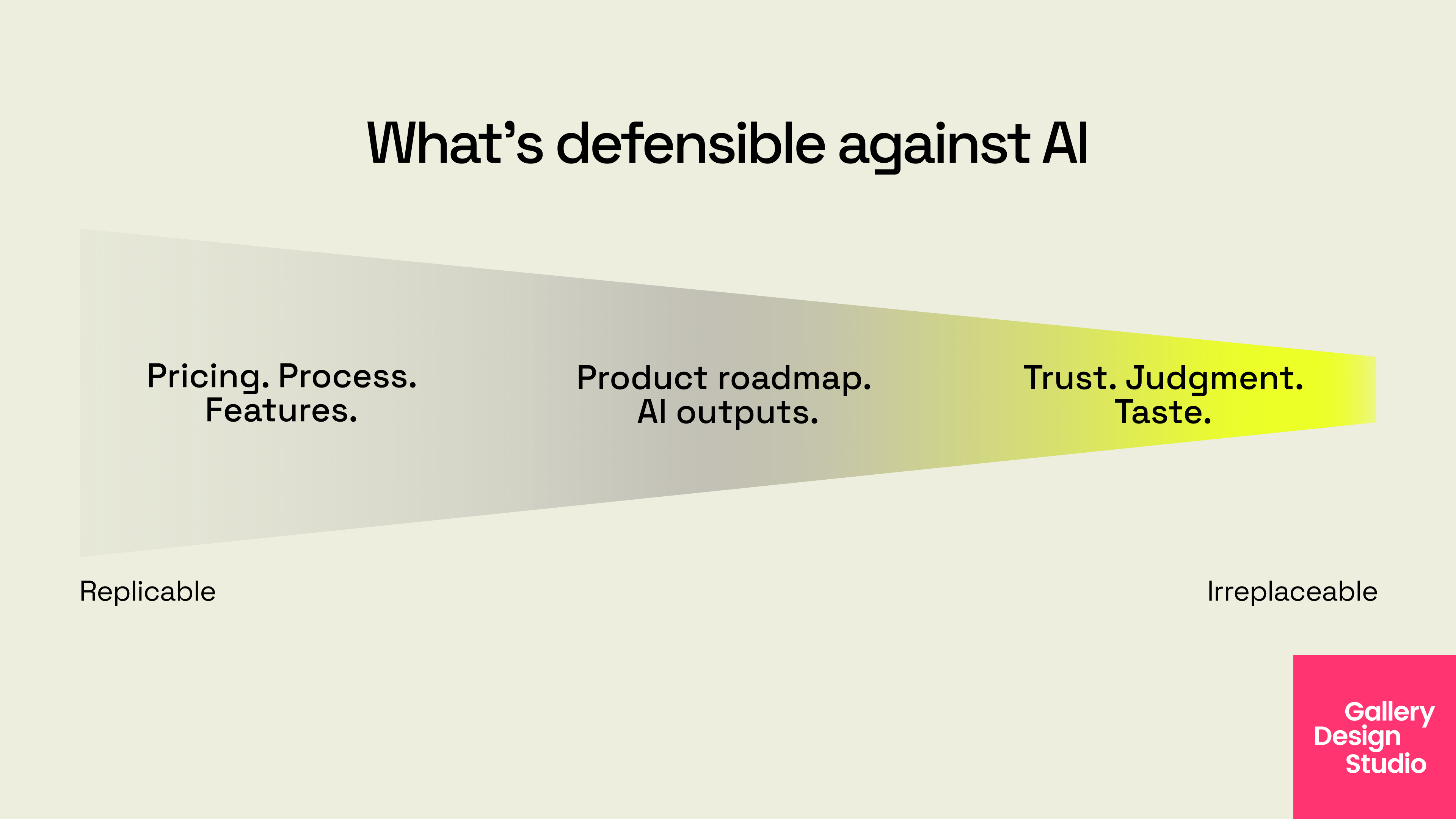
A point of view. A way of showing up that makes people feel something before they have read a single word. That takes years to build. It compounds slowly. Then all at once. You cannot AI your way to it. You cannot spreadsheet your way to it.
Automating creativity does not reduce risk. It makes the risk invisible until it shows up in revenue.
The Stakes Are Higher Than You Think
Graza sells olive oil. A commodity that has existed for centuries. They did not compete on the commodity. They competed on the story nobody was telling. Single origin. Not blended. Harvest timing. The difference between a drizzle and a cook. They built a brand around education delivered through personality and turned a grocery shelf staple into something people talk about, gift, and seek out by name.
That did not come from a prompt. It came from a decision to treat their customer as someone worth teaching. The result is not just a loyal customer base. It is a category they effectively own. No efficiency play built that. Creative authority did.
The brands buyers seek out and remember are not the ones that are optimized for volume. They are the ones with the strongest emotional pull. People do not remember what you said. They remember how you made them feel. The moment you remove the human variable from the interaction you remove the possibility of a peak moment. Peak moments create loyalty. Loyalty survives a competitor undercutting your price. Consistent but forgettable does not.
Where the Argument Falls Apart
The efficiency case for automating creative work rests on one flawed assumption. That consistency and distinctiveness are the same thing. They are not.
Consistency means your brand shows up the same way every time. AI delivers that. Distinctiveness means your brand shows up in a way no one else does. That requires judgment. Cultural instinct. The courage to be specific when everything in a risk-averse organization pushes toward generic. No tool trained on the aggregate of everyone else’s output produces that. You cannot prompt your way to original.
The result of automating creative judgment is a brand that is consistent but forgettable. Everything on spec. Nothing memorable. Faster than two years ago. Losing ground to competitors who look sharper. Speed did not solve the problem. Judgment would have.
Three Places It Breaks Down
- The repeatable gets optimized. The irreplaceable gets ignored.
AI handles the repeatable well. Resizing assets. Generating variations. First drafts at volume. The problem is when the work stops there. When the briefing process atrophies because the tool fills in the gaps. When nobody develops taste because the tool always has an answer. The team gets faster. The creative standard gets quieter. The brand stops landing and nobody can explain why. That is the cost of delegating judgment. - Volume without a spine.
Scale without a standard produces drift. Each AI-generated asset moves fractionally off-brand. Individually acceptable. Cumulatively, the buying group encounters three different versions of your company with different tones, different framings, different stories. Not because anyone made a bad decision. Because no one made the decision at all. That is a leadership failure, not a tools failure. The standard has to exist before the tool executes it. - The compounding effect gets missed entirely.
Becoming a company that takes its design seriously is not a rebrand or a campaign. It is a gradual shift in how buyers perceive you. Deals get easier to close because the brand does half the selling before the first meeting. Retention improves because clients feel they are working with a category leader. Talent that is genuinely hard to find chooses you because the work signals the standard. None of that shows up in a single metric. It accumulates. And the inverse is equally true. Every quarter spent optimizing for speed over creative judgment is a quarter your brand perception drifts further from where your product actually is. That gap is silent until it is not.
What Has to Change
Define what AI cannot touch.
The question is not whether to use AI. Every team is using it. The question is what you protect while you do. The customer interaction that determines whether a relationship continues. The creative decision that makes your brand recognizable in a crowded feed. The campaign that earns trust in a moment of uncertainty. Those are not tasks to automate. Those are the moments your brand is built or lost. Treat them accordingly.
Protect the peak moments.
Then map where your brand has the highest opportunity to make someone feel something. The first impression. The sales conversation that goes off script because someone actually listened. The follow-up after a difficult call. What happens in those moments determines whether you get remembered or replaced. You have to be there.
Invest in what doesn’t show up on a single dashboard.
A brand that earns a point of view over time makes deals easier to close, retention easier to maintain, and talent easier to attract. It is not because of any single campaign, but because of the accumulated weight of showing up with judgment and taste. That accumulation takes years. It also unravels quietly, one optimized-for-speed decision at a time, before anyone notices it in the numbers.
The brands that stand out over the next five years will not be the ones that automated fastest. They will be the ones that understood what to protect.
Differentiation is expensive by definition. The moment everyone has access to the same model, the same outputs, the same defaults, the tool stops being the advantage. What remains is the human who knows what to do with it.
AI is infrastructure. Great creative is still the product.
About Gallery Design Studio
Gallery Design Studio is a go-to-market creative partner for high-growth B2B technology companies. We work with a select number of companies to plan, structure, and produce the strategic visual content that moves complex deals forward. By invitation only. gallerydesignstudio.com


