
Nine Reasons B2B Companies Fail to Communicate Clearly
Sep 23, 2026
Author: Caroline Petersen | Editor: Steve Korver | Imagery: Anastasiia Hriaznova
Reading time: 8 min
Caroline Petersen founded Gallery Design Studio in 2015. Since then, she and her team have helped B2B technology companies turn their complex offerings into clear visual go-to-market content that buyers can quickly understand. She has been on both sides of the relationship described here – commissioning work from vendors and delivering it. More about Caroline.
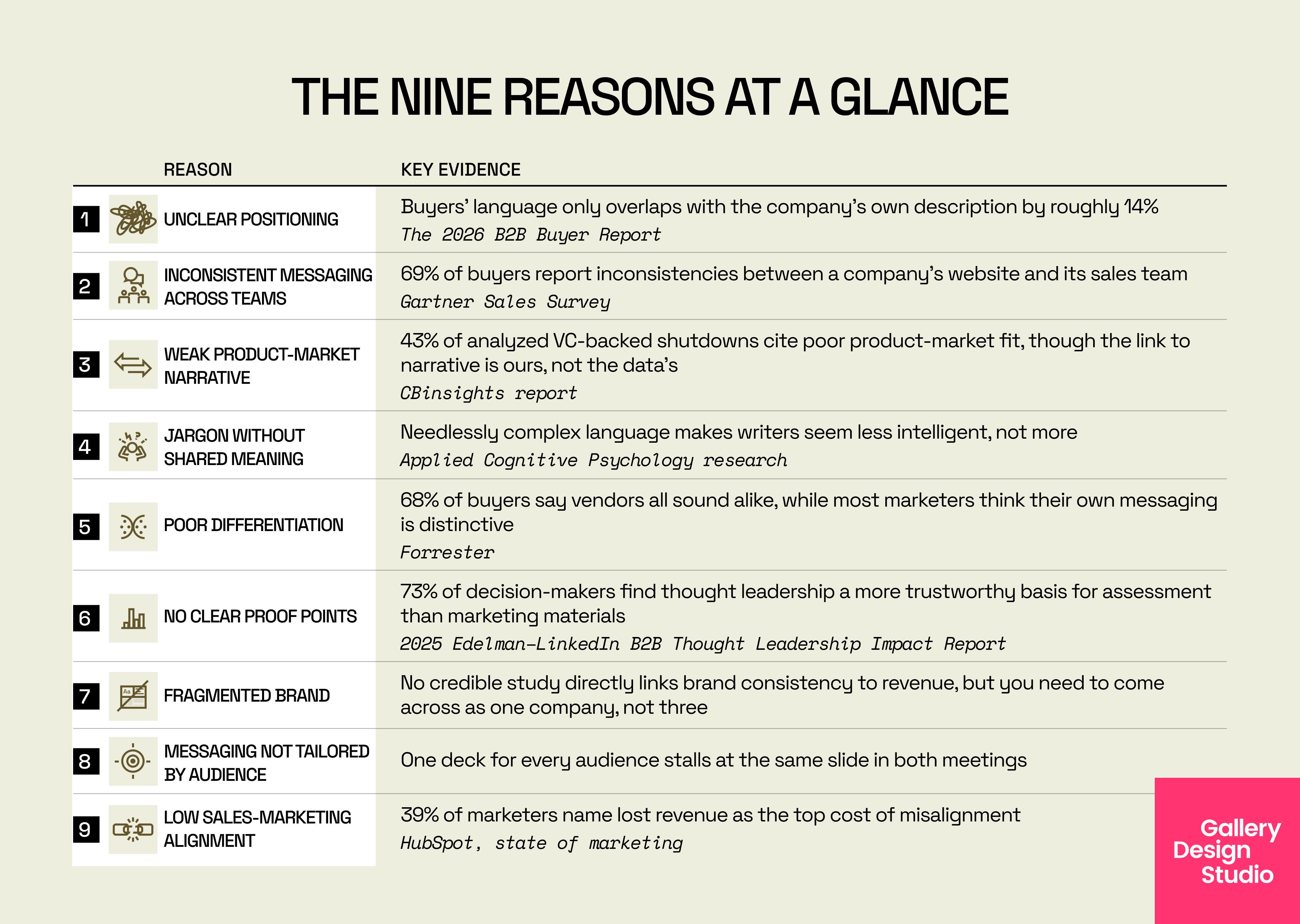
B2B communication fails when a company’s positioning, messaging, and proof don’t give buyers a clear reason to choose them over the next vendor. Across more than 150 collateral partnerships since 2015, the same nine patterns recur: unclear positioning, inconsistent messaging across teams, a weak product-market narrative, jargon, poor differentiation, missing proof, a fragmented brand, one-size-fits-all messaging, and sales-marketing misalignment. They share a root cause and rarely appear in isolation.
Key Takeaways
- Buyers and vendors routinely use different words for the same product, and buyers are the ones whose words decide the shortlist.
- Most buyers have picked a front-runner before a vendor presents. Clear collateral won’t beat an entrenched incumbent, but it largely determines whether you make the shortlist at all.
- All nine patterns stem from a single root cause: the gap between what a company does and what the market thinks it does. Gallery Design Studio calls this the perception gap.
- Where your deals stall tells you which of the nine to look at first, because they cluster by stage.
- Fix positioning first. Until you’ve decided what you’re claiming, there’s nothing for the messaging to be consistent with, nothing to differentiate, and nothing to tailor.
“I start noticing these because I got tired of starting engagements the same way: a founder explaining their company to me, clearly and fluently, then handing me materials that said none of it. After enough of those, the same nine gaps kept turning up. The problem is almost always that nobody decided what to say before someone was asked to say it.” — Caroline
Where This List Comes From
We only meet companies that already think something’s wrong. Mostly B2B technology and federal IT companies, from Series A to a few thousand people, who have decided the story was the problem before they reached out to us. So the sample is skewed in a way that flatters the list – we never meet the company with terrible positioning that wins anyway. Take it as a catalog of what walks through the door, not a measure of how common any of it is. When a section rests on what we’ve seen rather than published research, it says so.
Collateral clarity is also one lever among several, and not the largest. Trust, proof of similar work, and access to the rooms where decisions get shaped matter more, which is the argument for stacking small advantages rather than hunting for one differentiator.
Nearly all research in this field is published by companies selling something adjacent to the finding. Advertising networks find that vendors sound alike; PR firms find that thought leadership builds trust. Discount accordingly, including here – a studio publishing nine reasons you need clearer collateral is on that list.
We’ve written before about what unclear communication costs. This piece is about working out which of the nine is your problem. The quickest route is to look at where your deals tend to stall.
-
Unclear positioning costs the deal before the first meeting.
Forrester’s 2025 Buyers’ Journey Survey found that 68% of B2B buyers have a front-runner in mind at the very start of the purchase process, and that front-runner wins 80% of the time. However, positioning doesn’t create front-runner status. Installed base, analyst placement, and existing relationships mostly do. Positioning decides whether you’re in the running at all.
The 2026 B2B Buyer Report from Basis Global compared how brands describe themselves with how buyers describe those same brands in peer conversation. The language overlap is roughly 14%, and 83% of what buyers say contradicts the company’s own account of itself.
The usual failure is describing a category rather than a position within it. A cybersecurity vendor calling itself an identity security platform tells the buyer which aisle to look in and nothing about which box to take off the shelf. - Inconsistent messaging makes the buyer guess which version is true
Gartner’s 2025 buyer survey found that 69% of B2B buyers report inconsistencies between what a company’s website says and what they hear from its sales team. That’s a communication design problem, not a sales execution issue, and it starts before any asset is built.
The tell is about vocabulary. When the website says platform, the deck says solution, and outbound emails say tool, a buyer has to work out which word is load-bearing before they can evaluate anything. Most don’t bother, and nobody inside the company owns the story end to end well enough to notice.
Reason 8 argues for tailoring materials to the audience, and this doesn’t contradict it. Tailoring means changing which proof leads and how much depth follows. It doesn’t mean changing what you call the product or what you say it does. A CFO and a systems architect should hear the same sentence about what you sell, then get different evidence for it. - A weak narrative reads as a weak product
“Poor product-market fit” is the most-cited reason startups fail, and it covers two very different situations. CB Insights’ 2024 failure analysis looked at 431 VC-backed companies that shut down from 2023 onward and found poor fit topping the list at 43%. Two-thirds of those were early-stage companies that never found a market at all – a product problem, and nothing to do with storytelling.
The other third had traction and still lost. The data doesn’t say why. What we see is companies that have the fit and can’t articulate it: retention is healthy, the pipeline isn’t, and the pitch still opens with company history instead of the outcome customers are renewing for. - Jargon is only a problem where the shorthand isn’t shared
Nielsen Norman Group’s usability study with domain experts found that doctors, scientists, and engineers want what everyone wants: concise, scannable content. Its separate guidance on when technical jargon works adds the half most people skip. Keep the terms your audience already uses.
Explaining one they know talks down to them. In regulated and federal markets, acronym fluency is a credential. Swap the procurement term for plain English and you signal you don’t work here.
The problem was never technical language. Oppenheimer’s 2006 experiments found that needlessly inflated vocabulary makes writers look less intelligent, not more. Ask what the term refers to. “FedRAMP High” has an answer – a specific authorization level with defined controls. “End-to-end GTM content ecosystem” doesn’t say anything. - Without differentiation, the deck is interchangeable
Dentsu’s 2025 Superpowers Index, an advertising network’s own research, found that 71% of B2B buyers say vendors in their category all sound and act alike – while most marketers believe their own messaging is distinctive.
Two explanations fit that gap, and only one is a messaging problem. Either differentiated products are described identically, or the products are truly alike and the copy is telling the truth. No rewrite fixes the second case. What answers it is everything other than the product: proof from organizations like the buyer, evidence that you understand their context, and enough consistency that choosing you feels safe.
Positioning is what a company claims. Differentiation is whether the claim holds up against the alternatives. A company can hold a clear position that three competitors also occupy, which reads as clarity right up until the buyer opens the second deck.
The test is mechanical. Strip the logos from your deck and from the three you most often lose to, then hand them to someone who wasn’t in the room. If they can’t sort them, resist the urge to change the adjectives. Swapping “robust” for “resilient” still leaves the deck generic, and doing it across a few assets at a time is how the fragmented brand in reason 7 starts. - Claims without proof read as noise
The 2024 Edelman-LinkedIn B2B thought leadership report surveyed nearly 3,500 management-level professionals and found that 73% of decision-makers and C-suite executives consider an organization’s thought leadership a more trustworthy basis for assessing its capabilities than its marketing materials and product sheets.
Compared with product sheets, sales collateral is the format they trust least, which puts a heavy burden on every claim within it. “Reduced onboarding time significantly” and “cut onboarding from six weeks to nine days across its last three enterprise deployments” are the same claim. Only one of them changes what happens in the meeting. - A fragmented brand costs you, but not in the way the statistics claim
The 33% increase in revenue from a consistent brand presentation that everyone quotes comes from a brand-management software vendor’s survey of a few hundred brand managers who estimated their own results.
A 2026 analysis of 135 global brands measures brand value instead, which is partly built from financial results – closer to circular than causal. So nobody can tell you what a fragmented brand costs. What follows is an argument.
A buying group encounters you in pieces – different people, different assets, weeks apart. Consistency is what makes those encounters add up to one company rather than three. Inconsistency rarely arrives as a complaint, because nobody on the buyer’s side sees the whole set. It shows up in how confidently a champion describes you to someone who wasn’t in the room. - One message for every audience lands with none of them
A technical evaluator wants architecture and integration surface. A CFO wants payback period. A single deck built for both stalls at the same slide in both meetings, and the rep learns to skip past it rather than fix it. Build two versions of the evidence, not two versions of the product. - Sales-marketing misalignment compounds the other eight
HubSpot’s State of Marketing research from 2005 found that 39% of marketers name lost revenue as the biggest cost of sales-marketing misalignment, and 32% name lack of communication as the biggest obstacle to fixing it. The failure mode is two teams telling two versions of the story to the same buyer, in sequence.
Marketing promotes a capability that sales stopped leading with months ago. A buyer asks about it in a demo, the rep has nothing ready, and the buyer watches the company contradict itself.
Where your deals stall tells you which of these to look at
First, rule out the obvious. Deals stall for reasons that have nothing to do with communication: pricing, a champion who left, a frozen budget, a failed security review, a reorganization. Believe the specific non-communication reason your last five deals stalled.
If you are looking for a communication reason, start with the stage where deals consistently stall. These cluster by stage, and each cluster has a different tell.
If you lose before the first meeting. Look at reasons 1, 4, and 5. The symptom is low reply rates and shortlists you learn about after they’re set. The diagnostic is the swap test, plus asking three recent buyers to describe what you do in their own words. If their description is shorter and flatter than yours, that’s the gap.
If first meetings go well and follow-ups stall. Look at reasons 6 and 8. The symptom is enthusiasm in the room and silence after. The diagnostic is counting the checkable claims in your deck: named numbers, named outcomes, named organizations. If most of the deck is adjectives, the reader had nothing concrete to forward.
If deals stall late, at the champion. Look at reasons 2, 7, and 9. The symptom is a supportive contact who stops making progress internally. The diagnostic is whether a standalone document exists that makes the case with nobody there to explain it, and whether it says the same thing as the deck. Often it doesn’t exist, because everything was built for the live meeting instead of designing for the forward.
One exception to the stage rule. If you’ve never settled what you’re claiming, fix that first, whatever stage your deals stall at – the other fixes have nothing to work on until you do. If the claim is settled and deals still stall, it’s an execution problem, and the stage tells you where to start.
None of this reverses quickly. First impressions are rarely revisited, and once a buyer has filed a company under “hard to understand,” that description gets repeated in conversations the vendor never hears, long after the underlying problem is fixed.
Three diagnoses that send teams in the wrong direction
The first is blaming the product. Teams build features when the real gap is that buyers never understood the ones they had. It runs the other way too: if buyers understand you accurately and still pick someone else, the problem is the product or the price, and no amount of collateral will fix that.
The second is fixing one asset in isolation. A sharper one-pager doesn’t help while the website, the deck, and the sales team still tell three different stories, and the improved asset often makes the inconsistency more obvious.
The third is answering a clarity problem with volume. Blog posts, case studies, and social content layered on top of unclear positioning distribute the confusion more widely and more often. There is no quantity of content that resolves a question about what the company is.
FAQ
We’re hitting our numbers. Does any of this apply to us?
Growth hides the cost; it doesn’t remove it. The cost sits in deals nobody reports on, where buyers shortlisted three vendors and dropped you before any contact. If win rates are healthy but early-stage conversion isn’t, or if deals consistently require a long explanatory call before they progress, the collateral is doing less work than it should, and the sales team is absorbing the difference.
Who should own this internally?
One person, senior enough to overrule, and it usually can’t be the person who owns the collateral. Competing versions of a story almost always track competing beliefs about which segment the company is for, and that’s a question only leadership can settle. In practice the workable pattern is a single owner for the claim, whether that’s a founder, a CEO, or a head of product marketing with real authority, and distributed ownership for the expression of it. Splitting the claim across marketing and sales is what produces reason 2.
We sell into federal and enterprise procurement. Won’t sharp positioning get us filtered out?
Yes, it can. Requirements documents are scored on breadth, so a company that has narrowed its story to one differentiator can be cut before anyone reads it properly. The answer is to write two things. Cover the whole checklist where a scoring matrix does the filtering. Stay sharp everywhere a person is deciding. One document trying to do both scores adequately and convinces nobody.
How long does this take?
The claim itself can be settled in weeks once leadership agrees, and agreement is the slow part rather than the writing. Rebuilding the core materials to match runs a further one to two months depending on how many exist. What takes longer is the market catching up, because the description a buyer already holds doesn’t update on your schedule. Expect internal clarity quickly and external effect over two to three quarters.
Is this just a rebrand?
No, and treating it as one is a reliable way to spend a large budget without moving anything. Visual identity is one input to the fragmented-brand problem in reason 7 and irrelevant to the other eight. A company can complete a full rebrand and emerge with the same unclear positioning rendered in a better typeface.
What if the problem is the category rather than the company?
Sometimes it is. If buyers understand what you do but have no existing budget line or mental slot for it, that’s a category problem, and category creation is slower and more expensive than messaging work. Do prospects ask, “How is this different from X?” or “What is this?” The first is a differentiation problem. The second is a category problem.
Where to start
Find the stage where your deals stall. That narrows nine reasons to two or three. Start with positioning.
Every one of these reasons is the same failure. Your account of your company and the market’s account of it aren’t the same document, and only one of them is in the room when the decision gets made.
About Gallery Design Studio
Gallery Design Studio is a go-to-market creative partner for high-growth B2B technology companies. We work with a select number of companies to plan, structure, and produce the strategic visual content that moves complex deals forward. By invitation only. gallerydesignstudio.com


