
What a Luxury Watch Can Teach Us About Marketing
Aug 05, 2026
Author: Caroline Petersen and Noam Gissis | Editor: Steve Korver | Imagery: Zoe Mazlin
Reading time: 9 min read
It’s what lies underneath that makes communication really tick.
Recently, a client described what they were paying us for: website design, copywriting, and social media management. Fair enough. Those were the deliverables they could see. What they couldn’t see was our lead on the account quietly running about fifty initiatives behind the scenes, from event logistics to URL tracking, the operational and strategic work that makes the visible deliverables land where, when, and how they should.
No fault of the client’s. In sectors that rarely buy marketing, the visible layer is assumed to be the whole picture. So we went looking for a way to explain the rest. An obvious metaphor is the iceberg, and it’s plainly wrong. An iceberg is just a hidden mass, inert and vaguely threatening. What sits beneath good marketing isn’t mass. It’s motion.
So we started talking to leaders about watches.
Our attempt to better explain to leaders what it is that we do (without them necessarily seeing it), we leaned on the metaphor of the mechanics of a luxury watch.
Beneath the Dial
Ask someone why they admire a fine mechanical watch, and the answers are predictable: the gold case, the polished bracelet, or perhaps the diamonds set into the bezel. These are the features that catch the eye.
Ask a master watchmaker where the value lies, and the conversation shifts beneath the dial: a movement of more than a hundred small components, each doing one job with precision. Most owners will never see those parts or understand how they work together. But without them, the watch is nothing more than bling.
Marketing works the same way.
What Executives See
Most executives evaluate what is visible. They see the new website, the trade show booth, the product video, or the latest campaign. These are the polished surfaces of the business, tangible and easy to judge.
What they rarely see is the movement beneath the surface.
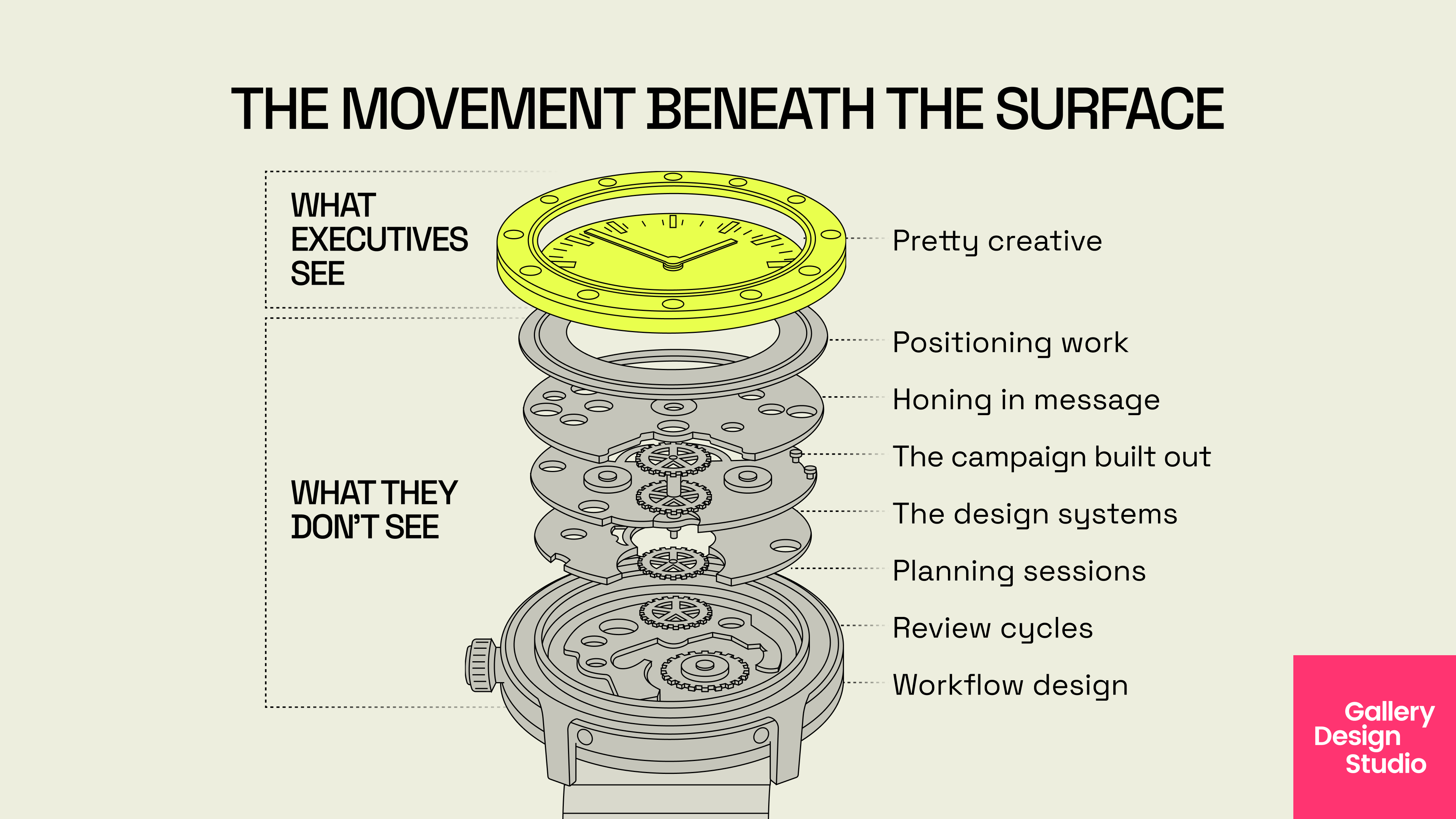
Some of it is plumbing: event logistics, tracking links, and production schedules. But the most valuable layer is architectural: the positioning work that keeps teams from contradicting each other, the messaging framework that lets product marketing, sales, and leadership speak with one voice, and the campaign architecture that connects launches, thought leadership, events, and sales enablement into a system. No one applauds a planning session. But that’s where hundreds of marketing decisions start reinforcing each other.
The blind spot is hardly surprising. Organizations value what they can observe, and intangible investment mostly isn’t observable. Haskel and Westlake call the result capitalism without capital: the spending that builds a capability rarely appears on a balance sheet. Barney made the companion argument decades earlier. Durable advantage comes from what competitors can't copy, which is almost never a single asset. It's a system.
Why Fragmentation Costs Deals
At the other end of all this invisible work sits a buyer, mostly on their own. Gartner research found that B2B buyers spend only about 17% of their buying journey talking to potential suppliers, and as little as 5% with any single sales rep. The rest is spent alone with your materials and those of your competitors.
The inconsistency between materials isn’t hypothetical. In another Gartner survey, 69% of B2B buyers reported inconsistencies between what a supplier’s website said and what its sales reps told them. Add a conference talk that tells a slightly different story in different language, and a product video that tells yet another. None of these are wrong, exactly. But it’s now the buyer’s job to reconcile multiple versions of you. And they won’t bother. Who has the time?
Companies in enterprise software, cybersecurity, industrial automation, and fintech rarely lose because they lack another brochure or landing page. They lose because every inconsistency asks the buyers to assemble the puzzle themselves, and each attempt costs them effort and costs you their confidence. Meanwhile, a competitor tells a story that the buyer can repeat to their CFO in seconds. That competitor makes the shortlist. In other words, clarity has commercial value.
A Simple Test
Open three things side by side: your homepage, your current sales deck, and the abstract from your last conference talk.
Would a stranger reading all three describe one company, or three? Could your head of sales and your head of product each explain what you do without contradicting each other?
If not, the assets aren’t the problem. There’s no movement underneath, no mechanism keeping the parts synchronized.
The Invisible Makes the Visible Work
When a customer quickly understands what a company does, this success disguises the complexity that made it possible. And that’s exactly how it should be.
Buyers don’t need to admire the gears. They need a communication system coherent enough that every visible touchpoint feels inevitable.
The buyer never sees any of this. They never read your positioning document or sit in your planning sessions. But when your website, your sales deck, and your conference talk all tell the same story, they are experiencing the movement. This time you make the shortlist.
Which is what we told our client. The website design, the copywriting, the social media: that’s the case, the crystal, the gold. What they’re really paying for is the movement.
People buy the watch because of the gold. They stay loyal because they trust the engineering.
The same is true of marketing. The visible assets capture attention. The system beneath them is what buyers come to trust, long after the shine wears off.
About Gallery Design Studio
Gallery Design Studio is a go-to-market creative partner for high-growth B2B technology companies. We work with a select number of companies to plan, structure, and produce the strategic visual content that moves complex deals forward. By invitation only. gallerydesignstudio.com


