
How to Evaluate Cultural Fit Before You Sign with an Agency
Sep 16, 2026
Author: Caroline Petersen | Editor: Steve Korver | Imagery: Anastasiia Hriaznova
Reading time: 6 min
Caroline Petersen founded Gallery Design Studio in 2015. Since then, she and her team have helped B2B technology companies turn their complex offerings into clear visual go-to-market content that buyers can quickly understand. She has been on both sides of the relationship described here – commissioning work from vendors and delivering it. More about Caroline.
Quick summary: Cultural fit decides what your budget buys. Two relationships can run the same process, with the same people, over the same number of hours, and produce work of different quality, because one spends those hours on the work and the other on managing suspicion. That puts fit in the evaluation alongside price and capability, while you still have leverage. Here is how to test it during a pitch, and how to tell a fit problem from ordinary disagreement once you are underway.
Key takeaways
- The same budget and the same team produce different work depending on the relationship they work inside.
- In a low-trust relationship, teams propose the most defensible idea rather than the strongest one, and the client pays full rate for the difference.
- Ordinary friction is specific and about the work. A fit problem arrives as an objection framed as an objective concern, usually before the work has been read closely.
- Fit is testable during the pitch: give a real note, ask who else will have opinions, and watch the first small disagreement.
- The standard runs both ways, and applies to the employees and vendors you hire as much as the clients you take.
What good fit / poor fit look like in practice
Over a year until mid-2026, we ran two client relationships that show what a fit problem actually costs.
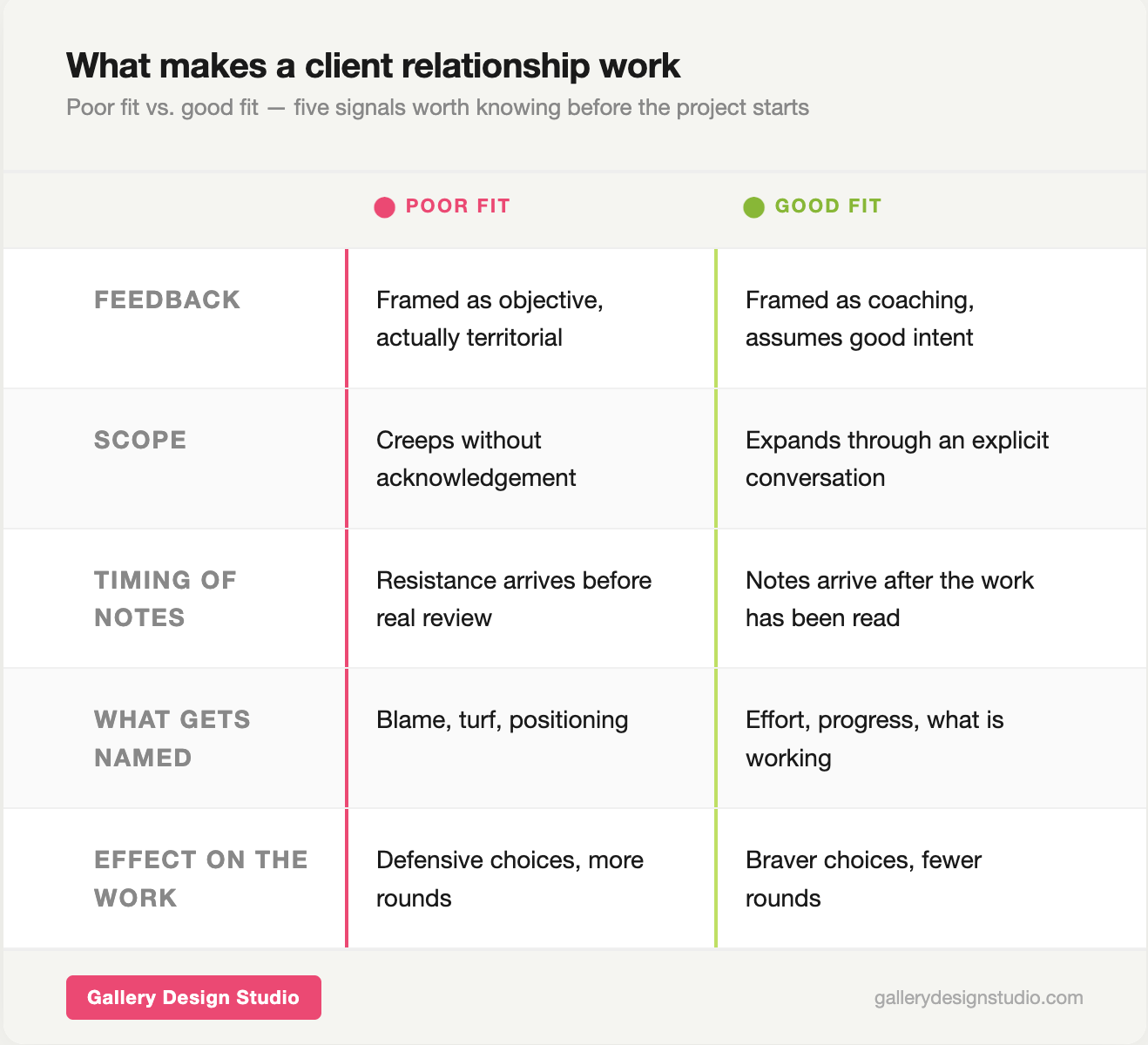
In the first instance, our deliverables met resistance before anyone looked at them closely. We went out of scope more than once to absorb shifting asks, yet the response was still that nothing landed. The notes didn’t read as being about the work. They read as territory, as someone needing to be seen pushing back. “This isn’t on brand” sometimes means “I need a win in this meeting.”
The second relationship expanded after the first phase, and not because the process was flawless. There were real revisions and real friction. It expanded because the client experiences it as a partnership: they give notes the way you would coach a teammate, they assume good intent, and they say when something is working rather than only when it is not.
Same studio, same process, same people, same standard of work going in. What differs is how the relationship affects that work on the way out.
Low-trust clients pay full rate for the second-best idea
In a low-trust relationship, teams pre-defend. They stop proposing the strongest idea and start proposing the most defensible one, because the strongest idea takes three meetings to justify while the safe one takes one. Nobody decides to do this. The safe option is cheaper to produce, so over a long engagement it wins.
You can watch it happen during an internal review. Someone says the good version out loud, then talks themselves out of it before anyone else has to.
The client never sees what they didn’t get. They receive competent work, on time, at the agreed rate, and have no way to know that a braver version was considered and abandoned. It is the one consequence of poor fit that never appears on an invoice.
Fit is the multiplier on budget and capability
Price and capability set the ceiling. Fit decides how much of it you reach.
A study from 1998 in Organization Science by Akbar Zaheer, Bill McEvily and Vincenzo Perrone tested 107 buyer-supplier relationships and found that trust between two organizations improved the performance of the relationship directly, rather than by making negotiation cheaper. These turned out to be separate effects, which was not what the authors expected.
The employee research points in the same direction at a much larger scale. A January 2022 analysis in MIT Sloan Management Review of 34 million employee profiles found that toxic culture was the strongest predictor of attrition during the Great Resignation, 10.4 times more predictive than compensation.
Creative work is more exposed to this than most, because there is no right answer to check against. You have to trust that the studio knows what it is doing. The studio has to trust that your notes are given in good faith. Remove either and every round becomes a negotiation instead of a collaboration.
Ordinary friction is specific and about the work
Every real working relationship has friction. The question is whether the friction serves the work or something else.
A note that says the third option reads as cold, or that the second paragraph buries the offer, is about the work. You can act on it, argue with it, or show it’s wrong. A note that arrives before the deck has been opened, phrased as an objective concern that nobody can respond to, is about something else. The timing is usually the tell, not the content.
Easy agreement is a weak signal. A partner who never disagrees with you either is not reading the work closely or has already started pre-defending. Our earlier piece on constructive and political feedback goes into how to tell them apart in the moment.
Cultural fit is a claim about how disagreement gets handled
The term “cultural fit” has a problematic history, and it is worth distinguishing what it means here from what it usually means.
In a 2012 study of hiring at elite professional firms, Lauren Rivera drew on 120 interviews with hiring professionals and found that employers selected candidates who resembled them in leisure pursuits, experiences, and self-presentation, and that shared-culture concerns often outweighed productivity concerns. That is the standard critique of fit, and it is earned. Used as a hiring filter, fit tends to collapse into similarity, and similarity narrows an organization to people who already agree.
The difference is testable. Similarity asks whether the other party resembles you. Every test in this piece asks what happens when they do not: whether a real note gets engaged with, who is allowed to disagree, how the first small conflict is handled. A partner who agrees with everything scores badly on all of them.
Screening for people who will not push back is screening for agreement, and it costs you the same way low trust does, through the ideas you never hear.
We have agreed to poor fit too, and it cost us
We have been the difficult party. Early on we took accounts we knew were a poor fit because the number was good, and told ourselves the work would win people over. It did not. It got quieter and safer until it was done, and then we blamed the client.
Poor fit doesn’t happen to a studio. It is something a studio agrees to, usually in a room where everyone can see the risk and nobody wants to name it. The test below is the one we now run on ourselves before we sign.
How to test for fit before you sign
Fit is more knowable up front than most buyers assume. Five things worth doing during evaluation:
- Give a real note during the pitch process and watch what happens. Engagement looks like a question back. Management looks like agreement followed by nothing changing.
- Ask who signs off, and who else will have opinions. A long, unnamed second list is where political feedback comes from later.
- Ask what happened on their last engagement of this kind, and listen for whether the previous partner is described as a collaborator or a culprit.
- Watch the first small disagreement. How a relationship handles a minor one predicts how it handles a real one.
- Notice whether anyone names something they like. A partner who only ever flags problems will only ever flag problems.
All five happen inside meetings you are already having.
The same standard applies to the vendors you hire
A vendor who shares your standards and treats disagreement as part of the job will outperform a technically stronger vendor who makes every exchange adversarial, for the same reason and by the same mechanism: the stronger vendor’s best ideas never reach you.
Most companies rigorously screen job candidates for fit, yet they skip the question entirely when choosing an employee, an agency, a contractor, or a client. The test above works for all four.
Three mistakes that keep fit problems hidden
Treating fit as something to sort out later. It does not sort itself out. It resurfaces as scope creep, defensive notes, and slow decisions, at which point it looks like a delivery problem and gets managed as one.
Reading friction as poor fit, or easy agreement as good fit. Good fit tolerates real disagreement. What it does not tolerate is disagreement that is secretly about something else.
Applying the standard to candidates only. The same company that runs a structured fit interview for a junior hire will pick an agency on price and chemistry in a single call.
Frequently asked questions
What if the best-priced option is clearly a poor fit?
Price the gap rather than ignoring it. A low-trust relationship usually costs extra rounds, longer approvals, and internal time spent managing the relationship rather than the work. If the cheaper option requires two additional revision cycles per project, that difference is often larger than the rate gap. If it is not, take the cheaper option knowingly and set the terms tightly enough that the extra rounds are scoped.
Can a poor-fit relationship be repaired once it is underway?
Sometimes, and only by naming it directly. The usual fix is structural rather than interpersonal: reduce the number of people giving notes, agree what a note must contain to count as one, and put a single named approver on each stage. What rarely works is trying to earn trust by absorbing more out-of-scope requests, which reads as confirmation that the pushback was warranted.
How do you raise a fit problem without sounding like you are blaming the client?
Describe the pattern in terms of cost rather than character. “We are at four rounds on a piece that was scoped for two, and the notes are arriving before the review call” is a fact about the process. “Your team does not trust us” is a verdict on people, and it will be argued with rather than acted on.
What if the fit is good with your day-to-day contact but poor above them?
This is the most common and most expensive version because your contact absorbs the pressure and you only see it as unexplained reversals. Ask to be in the room for at least one review with the person who actually signs off. If that is repeatedly refused, you are not working with the decision-maker, and no amount of rapport with your contact will change what happens to the work.
Both projects shipped, and both were good.
Both of our relationships produced work we would stand behind. Both clients paid the same rate. Reading the finished files side by side, neither client could tell you which one received our strongest thinking.
That is what makes a fit problem hard to catch after the fact. It does not show up as a flaw in the deliverable. It shows up as an idea that was never proposed, in a version of the work that is perfectly good but simply is not the best available. There is nothing to audit, because the thing you would be auditing for never got written down.
The client who got the better work was not the one who agreed with us most. It was the one whose notes were always about the work, so we never spent a round guessing what they were really about.
So do not rebuild your procurement process. Take the five tests above into the next evaluation you are already running, and give a real note in the first meeting. How that note is handled will tell you more than any reference call, and it costs you nothing to find out.
About Gallery Design Studio
Gallery Design Studio is a go-to-market creative partner for high-growth B2B technology companies. We work with a select number of companies to plan, structure, and produce the strategic visual content that moves complex deals forward. By invitation only. gallerydesignstudio.com


