
How Do You Know Your Go-To-Market Is Actually Working?
Oct 06, 2026
Authors: Caroline Petersen and David LaCombe | Editor: Steve Korver | Imagery: Anastasiia Hriaznova
Reading time: 6 min
Caroline Petersen founded Gallery Design Studio in 2015. Since then, she and her team have helped B2B technology companies turn their complex offerings into clear visual go-to-market content that buyers can quickly understand. David LaCombe is a fractional CMO who spent two years interviewing more than 130 business leaders about how marketers build judgment. In Episode 12 of the Growth by Creativity podcast, they discuss why most go-to-market failure is a diagnosis problem, and how a pre-mortem catches it before the budget goes.
Before David LaCombe became a fractional CMO, he was a paramedic. In an emergency, assessment begins while you’re still approaching the patient. Signs of injury. Blood loss. You don’t wait for the chart. Those instincts shape everything he does now, as he walks into companies where growth has stalled.
Most go-to-market (GTM) teams do the opposite. They can’t tell whether their go-to-market is working until it’s too late. They find out in the post-mortem, after the budget is spent and the quarter is gone.
On the episode, Caroline and David got into why that happens and what to do instead. The conversation kept returning to one idea, which David summed up as “diagnosing before we prescribe.” Most go-to-market failure isn’t a talent problem. It’s a diagnosis problem.
Key takeaways
- Silos are good people doing good work with no shared goal, and the silence they produce can look like alignment.
- A pre-mortem assumes the launch has already failed and asks why. That gets the quiet people talking before any money is spent, but only if the CEO or their designate runs it.
- Customers who say they love a feature haven’t told you anything until you ask whether they’d buy it today.
- An ideal customer profile without a no-call list is a wish list. Accounts that never belonged cost you in rework and slow churn.
- If each function is measured differently, that’s where alignment will break.
- Start GTM conversations with acquisition cost, churn, and profitability, and agree on a kill switch before capital goes out.
Silos are good people with no shared goal
Ask any leadership team if they have a silo problem and they’ll say yes before you finish the sentence. Ask them to define it, and the room goes silent.
Caroline’s definition: people doing good work, independently, without a common goal. David added the budgets. Everyone has their own, along with their own metrics, and underneath it all, customer acquisition costs are rising. No one can trace them to a single cause because no one owns the whole picture. “Sometimes people forget that we should all be rowing in the same direction,” Caroline said, “as opposed to trying to do our own play.”
Sometimes silos are an ego problem: inside one, people can work their own way. Underneath, David said, there’s usually fear of being blamed, or overconfidence in something that worked before. “The universe gets a vote.”
So the confident push ahead, the fearful stay quiet, and the silence starts to look like alignment. When it breaks, the blame starts. David has no patience for that: “It’s really a signal to say I don’t know how to do my job, and so I’m going to blame other people.”
The pre-mortem changes the question
The standard question before a launch is: “Do you like the strategy?” That question requires someone junior to tell someone senior “No” in a room, in real time. Almost nobody has the authority or the nerve to do that.
David promotes a fix called a pre-mortem, and the technique has a history. Cognitive psychologist Gary Klein formalized it in a 2007 Harvard Business Review article. Instead of asking whether the strategy will work, you tell the room: “I want you to assume our strategy has failed. It’s just simply not working.” The team then performs an autopsy on something that hasn’t happened yet.
The research Klein cites, a 1989 study by Deborah Mitchell, J. Edward Russo, and Nancy Pennington, found that prospective hindsight (imagining an event has already occurred) improves the ability to correctly identify reasons for future outcomes by roughly 30%. In David’s experience, the shift lets “the silent people who are actually going to do the work” speak up and say, “No, this is why it’s going to break down.” The ideal customer profile (ICP) was never updated. The messaging was never validated. The partners in the plan were never looped in. Things that should have surfaced during strategy formation finally show up before a single dollar is spent.
The CEO, David said, should be “more interested in the truth than they are about defending a particular assumption.” And the room needs to hear that up front: “Let people know that this isn’t a matter of who’s right. You’re actually starting to collect a list that you can test.”
The launch date already exists; the pre-mortem runs before it. Everyone with a stake is in the room: product, marketing, sales, customer experience, support, and finance. Testing the concerns doesn’t take long, because most answers are already known somewhere in the building. Then they’re prioritized. And finance gets a vote: until the team is confident the ICP is right, the funds aren’t authorized. “If you’re sitting in a room of chaos where people are just butting egos and you can’t align,” David said, “I wouldn’t give you the money.”
Nobody asks whether customers would buy it today
David sees this pattern so often that his example is a composite of several companies. An engineering group builds a product innovation, or two companies form a partnership that promises one plus one equals five. They show it to customers, who say exactly what polite customers say: “Wow, that’s really cool! I love this feature.” Nobody asks the questions that matter: “Would you buy it? Would you buy it today? Would you stake your reputation on bringing this opportunity forward?”
So the thing gets baked. Messaging gets built around it. A full GTM team gets funded, target list ready. And then the market answers: “Yeah, we’re not actually trying to solve this problem right now.” By then the budget is already disappearing.
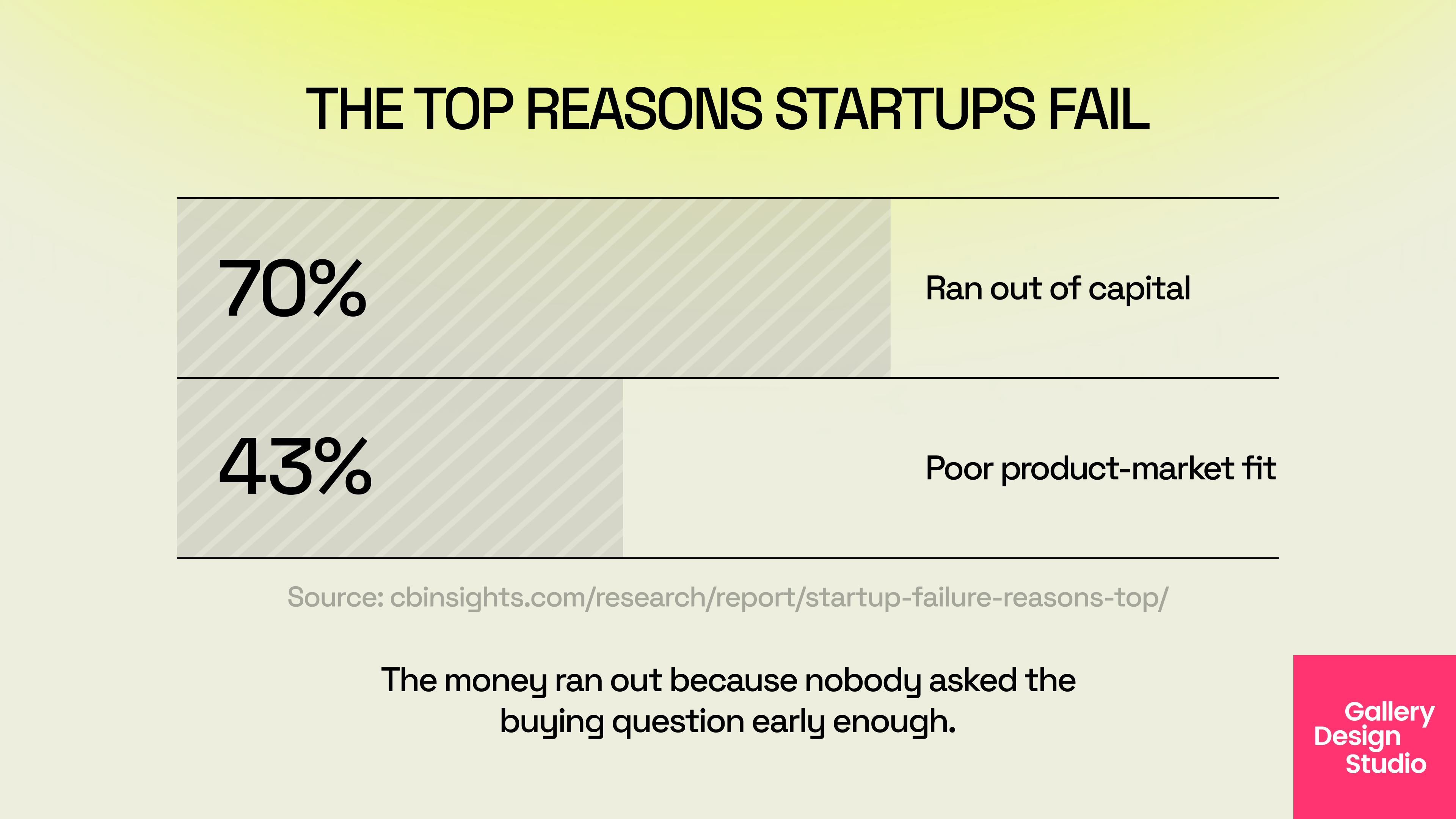
A March 2026 CB Insights analysis of 431 venture-backed startups that have shut down since 2023 found that 70% ran out of capital. CB Insights reads that as the final event and looks behind it for causes. The most common underlying one was poor product-market fit, at 43%. The money ran out because nobody asked the buying question early enough.
Without real demand, David said, no amount of ad spend or extra sales hires will make it work. “I think one of the greatest disservices that we’ve ever done to our profession is to create roles like demand marketers and then hold them accountable to create demand where there is no demand.”
Know your no-call list
David asks clients an uncomfortable question. Who is your no-call list? Who do you not want to do business with?
Most teams can’t answer, because their ICP describes ideal buyers and rules out no one. “They’ll look at me like that’s not the ICP,” David said. “I’m like, that’s exactly it.” A company that won’t name who it should walk away from pays for it later. The cost is less in acquisition than in keeping an account happy when it never belonged on the roster: rework with no additional billables, and slow, expensive churn that everyone saw coming and nobody stopped. “Why do we keep trying to make somebody happy who doesn’t even belong on our customer list?”
Alignment breaks where compensation breaks
“I think the word alignment is really overused,” David said. If you want to find out where a GTM team’s alignment actually lives, ask each function how they’re measured for success. When the answers are all different, you already know where the breakdown will happen.
When part of someone’s pay depends on a bonus, commission, or profit share, “trust me, people know exactly how to earn that.” A team can hit every individual number in the plan and still miss the company’s actual goal, because nobody’s pay was tied to that goal. As David put it, “they’re going to do the thing that gets them paid.”
Start with the financials, not the campaign
“If it begins with ‘we want to do a campaign,’ I think we’ve started in the wrong spot,” David said. The same goes for starting with a push to win more new customers.
Start with customer acquisition cost, churn, and profitability relative to revenue. The financials won’t always tell you why something is broken, but they’ll tell you where to look.
Why is profitability eroding? David’s answer: Go back into the P&L. You keep shipping replacement parts to the same customer. The support team has been physically traveling to the account, and the travel budget is up 300%. “You can find the hemorrhage, you can find the lesion, the business problem pretty quickly from the financials.”
David now brings finance in before launch, and the most important thing they agree on is what happens if the initiative goes off the rails. He calls it the kill switch: conditions, defined before any capital goes out the door, under which you’d pause. “Pause doesn’t have to be viewed as an insult or a defeat,” he said. “It just means capital is finite.” Burning it while you reorient is a preventable loss.
The client relationship has to run both ways
Toward the end, David turned the question on Caroline. How does an agency assert what it knows works in the market when a client sees it differently?
Her answer was that it depends on the client. Some are open-minded: they bring their own information and context, and they’re willing to hear GDS out. Others want it their way with no wiggle room, which she called “a huge missed opportunity.” And she didn’t exempt GDS: “Maybe there’s things that we’re missing.” In her words, “It just has to be ultimately a two-way thing.”
That’s the humility David asks of a CEO running a pre-mortem, applied to the people giving the advice. A relationship where only one side listens costs both of them.
Most go-to-market initiatives don’t fail because the idea was bad. They fail because nobody diagnosed before they prescribed. The pre-mortem is the walk-up assessment, and the cheapest insurance a GTM team will ever buy.
Growth by Creativity is a podcast hosted by Caroline Petersen and David LaCombe, released every two weeks.
About Gallery Design Studio
Gallery Design Studio is a go-to-market creative partner for high-growth B2B technology companies. We work with a select number of companies to plan, structure, and produce the strategic visual content that moves complex deals forward. By invitation only. gallerydesignstudio.com


